
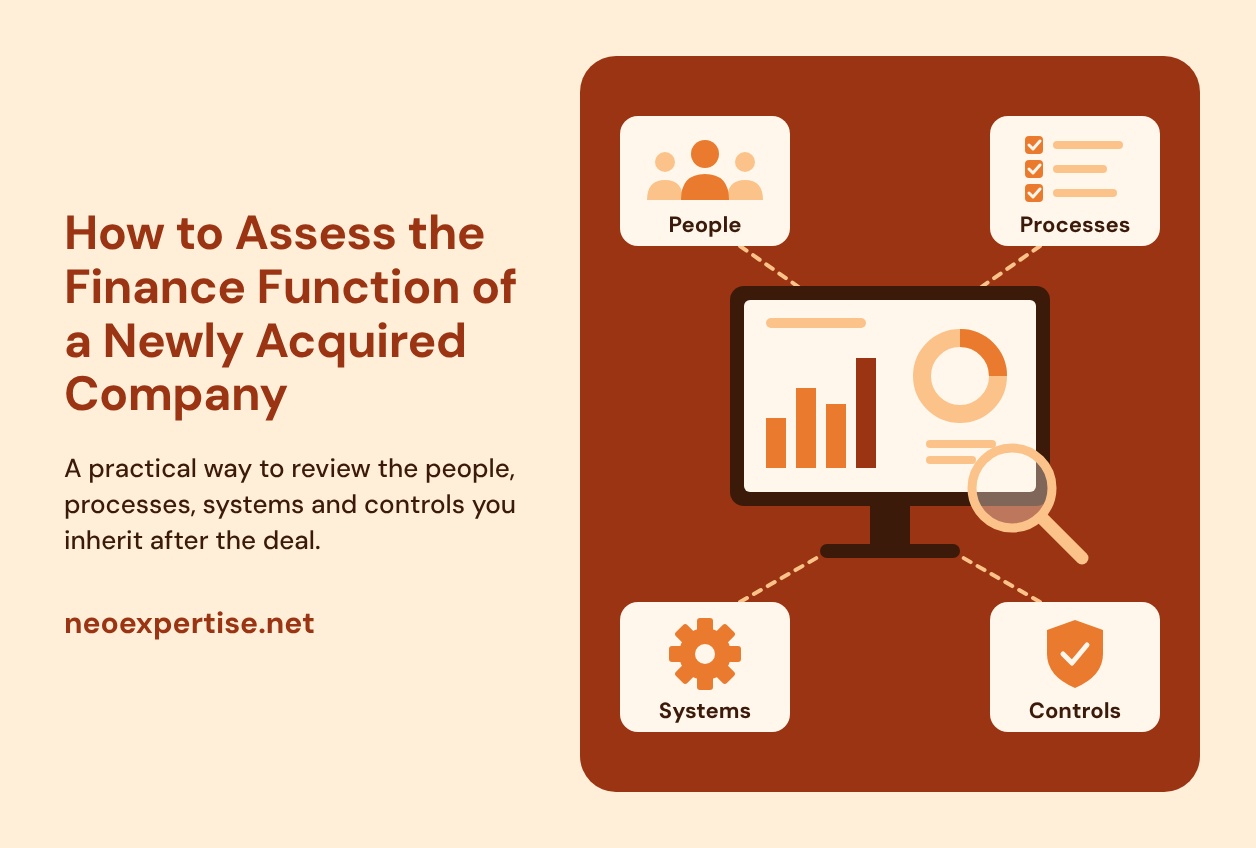
Once a deal closes, the Group CFO inherits not just a balance sheet but a finance team, a close process, and a set of systems that have to feed Group reporting. To assess the finance function of an acquired company is to work out, quickly and honestly, whether that machinery can produce reliable numbers on the Group’s timetable, or whether it needs support before the first consolidation. This is not the same as reviewing the balances themselves. It is a review of the capability that produces them: the people, the monthly close, the systems, the controls, and the quality of the underlying data. This article sets out the five dimensions to assess, a step-by-step method, and an illustrative scorecard you can adapt.
Key takeaways
- Assessing the finance function means judging the capability that produces the numbers, not re-checking the numbers themselves.
- Score five dimensions: people and roles, the close process, systems and tooling, controls, and data quality.
- Run it in the first three to four weeks, while the acquired team can still explain how things actually work.
- The output is a capability scorecard and a short list of where Group Finance needs to add capacity before the first close.
In this article
What “assessing the finance function” means
Assessing the finance function is a structured judgement of whether the acquired company can produce reliable financial information on the Group’s schedule. It looks at capability, not at individual balances. A balance review asks “is this receivables figure supported”; a finance function assessment asks “can this team produce a supported receivables figure every month by working day five”.
The distinction matters because the two need different fixes. A wrong balance is corrected with a journal. A weak function is fixed with people, process, or systems, and those take longer to put right, which is why the assessment has to happen early. It sits alongside the balance work described in what a CFO should review after an acquisition and feeds the sequence in the first 100 days finance integration roadmap.
The five dimensions to assess
Score the function across five dimensions. Each has a specific artefact you ask for and a specific question it answers.
People and roles
Org chart, roles, key-person dependencies
Who does what, who could leave, and is any critical process held in one person’s head?
Close process
Close calendar, task list, actual close dates
How long does the monthly close take, and can it meet the Group deadline?
Systems
ERP, sub-ledgers, spreadsheets in the chain
What produces the numbers, and how much sits in uncontrolled spreadsheets?
Controls
Reconciliation log, approval matrix, segregation
Are balances reconciled and approved, or booked and forgotten?
Data quality
Chart of accounts, master data, aging reports
Is the underlying data clean enough to map to the Group chart and consolidate?
How to run the assessment, step by step
Run this over three to four weeks, in parallel with the balance review, not after it.
Step 1. Request the working artefacts, not the outputs. Ask for the close calendar with actual sign-off dates for the last three months, the reconciliation log, the org chart, and a system inventory. Ask for these from the acquired finance team directly, not from the deal data room, because the data room holds the version prepared for buyers, not the version the team runs on day to day.
Step 2. Walk one full close with the team. Sit with the controller and trace a single monthly close end to end. This is where key-person dependencies and undocumented workarounds surface, because you see which spreadsheet feeds which journal and who is the only person who knows.
Step 3. Test three reconciliations against source. Pick bank, a control account such as AR, and one accrual. Trace each to its supporting documentation. Consistent accounting policy application is a reporting obligation under the EU-endorsed IAS 8, published on EUR-Lex, so note where local policy differs from the Group basis.
Step 4. Score each dimension red, amber, or green against a defined standard, and write one sentence of evidence per score. A score with no evidence is an opinion, not an assessment.
Step 5. Convert reds into a capacity plan. Every red becomes an action with an owner and a date, feeding the integration tracker rather than sitting in a report.
Illustrative example: a finance function scorecard
The scores below are illustrative, not a real client engagement. They show the shape of a scorecard for a mid-market target of roughly 45 million euros in revenue with a four-person finance team.
| Dimension | Score | Evidence |
|---|---|---|
| People and roles | Amber | Controller holds the entire close in spreadsheets; no cover if absent |
| Close process | Red | Close lands on working day 11; Group deadline is working day 5 |
| Systems | Amber | ERP for GL, but AR aging and payroll journal built in Excel |
| Controls | Red | No reconciliation log; 3 balance-sheet accounts unreconciled for 8 months |
| Data quality | Green | Chart of accounts maps cleanly to the Group chart with 6 exceptions |
Two reds and two ambers on a business of this size point to a capacity gap of roughly one experienced finance resource for two to three months, focused on the close and on reconciliations, not to a wholesale replacement of the team. The single green tells you the data foundation is sound, so the fix is process and support, not a system change. Preparing that same entity for its first consolidation is covered in preparing a newly acquired subsidiary for group reporting.
Warning signs the function is weaker than it looks
Some weaknesses do not show up in the headline numbers, which is exactly why they get missed.
- A clean-looking close that lands late. If the last three closes signed off on working day 10 or later, the entity cannot meet a working-day-5 Group deadline without support, however tidy the output looks.
- Reconciliations that exist but are never reviewed. The most common failure mode is a balance-sheet account that reconciles to itself in a spreadsheet nobody signs. It looks controlled and is not, and it typically breaks at the first audit sample.
- One person who can explain everything. When only the controller can trace how a number is built, the function has a single point of failure that becomes urgent the moment that person leaves, which acquired-company finance managers often do soon after closing.
- Adjustments concentrated at year end. A stack of manual entries in month 12 usually means monthly figures were approximate all year, so the monthly numbers cannot be trusted for Group reporting as they stand.
When a full assessment is not the first priority
A full five-dimension assessment is not always the first move. If the acquired entity already runs on the same ERP as the Group, closes to a comparable calendar, and keeps a reviewed reconciliation log, a light-touch confirmation is enough and the effort is better spent on balance substantiation.
It is also the wrong tool when the real issue is a single known gap, for example a controller who has already resigned. In that case the priority is knowledge transfer and interim cover, not a scorecard that will only confirm what you already know. For serial acquirers, the standard approach is to run the same scorecard on every deal so results are comparable across the portfolio, as set out in the finance integration playbook for serial acquirers. Under the UK Companies Act 2006, directors must keep adequate accounting records, so a function that cannot evidence its balances is a governance issue, not only an integration one.
Working with NEO Expertise
NEO Expertise provides additional operational finance capacity to Group CFOs during integration. We can run the finance function assessment, then stay to close the gaps it finds, whether that is protecting the monthly close or clearing a reconciliation backlog. Need additional finance capacity after a deal closes? Discuss your finance integration project with our team.
FAQ
What does it mean to assess the finance function of an acquired company?
It means judging whether the acquired company’s finance capability can produce reliable numbers on the Group’s timetable. The assessment scores people, the close process, systems, controls, and data quality. It reviews the machinery that produces the numbers, not the individual balances, which are checked separately.
How long should a finance function assessment take?
Plan three to four weeks, run in parallel with the balance review rather than after it. That is enough time to request the working artefacts, walk one full monthly close with the team, test a few reconciliations to source, and score each dimension with evidence before the first Group close depends on the numbers.
What is the difference between a finance function assessment and a balance sheet review?
A balance sheet review asks whether a specific figure is supported. A finance function assessment asks whether the team can produce supported figures every month, on time. One is fixed with a journal, the other with people, process, or systems, so the assessment must happen early because capability fixes take longer.
Who should run the assessment?
The Group Financial Controller or an integration lead should own it, supported by external finance capacity where the Group team is stretched. It needs someone senior enough to judge a close process and a control environment against Group standards, and independent enough to score the acquired team honestly.

Brahim Rami | Member of institute of chartered accountants in Morocco
He is a CPA and tax advisor, founder of NeoExpertise.net, a Legal and Tax firm helping foreign companies with business setup, due diligence, payroll, and tax compliance in Morocco and Africa.