
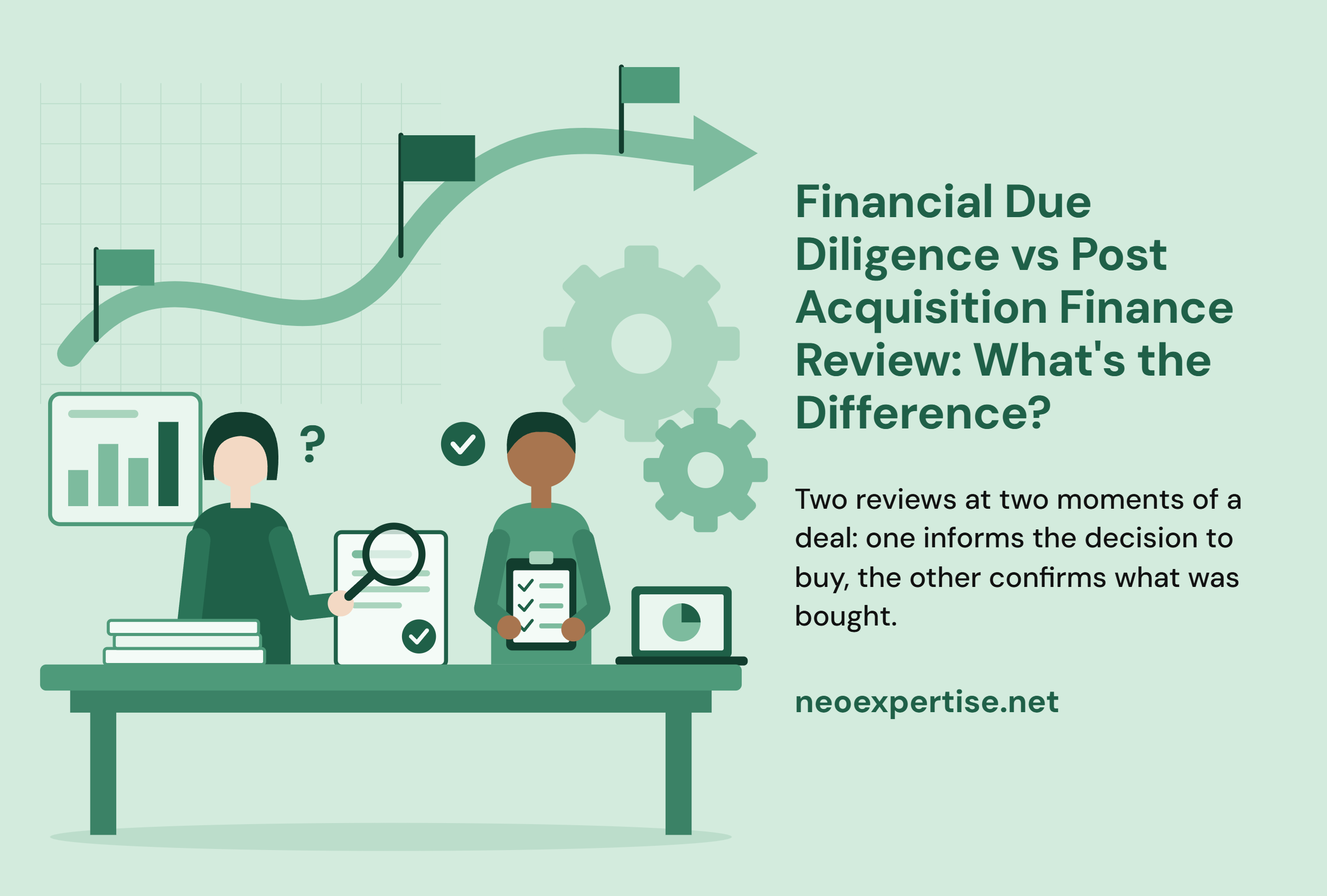
Two finance exercises sit either side of a completed deal, and they are easy to confuse. The distinction between a post acquisition finance review vs due diligence is not academic: it decides who owns the numbers, what data they can see, and what they are trying to prove. Financial due diligence runs before signing, on data the target chooses to share, to answer whether the deal is worth doing. A post-acquisition finance review runs after closing, with full access to the general ledger, to make the acquired company’s numbers reliable enough for the Group’s own reporting. This article sets out where the two differ, where they overlap, and what a due diligence exercise routinely leaves for Group Finance to clean up.
Key takeaways
- Due diligence is a pre-deal risk assessment on sampled, management-prepared data. A post-acquisition finance review is a post-deal reliability exercise on the full ledger.
- Due diligence answers “should we buy, and at what price”. The finance review answers “can we report these numbers to the board, the lender, and the Group close”.
- Due diligence works from schedules the target prepares. The finance review works from the accounting system directly, including accounts no one chose to present.
- The two are complementary, not substitutes. A clean due diligence report does not mean the balance sheet will survive a Group close.
In this article
What financial due diligence is
Financial due diligence is a pre-completion investigation that supports the decision to buy and the price paid. It tests the quality of earnings, the sustainability of margins, the working capital profile, and the net debt position, so the acquirer can price the deal and set the completion mechanism.
It is built on sampling and on schedules the target’s own finance team prepares. The diligence team asks for a data pack, tests it against a materiality threshold, and reports exceptions. Anything below that threshold, and anything the target did not surface, sits outside the scope by design. Due diligence is time-boxed, adversarial in tone, and framed around deal risk, not around whether every balance is supported.
What a post-acquisition finance review is
A post-acquisition finance review starts once the deal closes and reporting responsibility moves to the Group CFO. Its purpose is reliability: can the acquired entity’s trial balance be trusted for board reporting, lender covenants, and the next consolidation. It works from the general ledger directly, not from a curated data pack, and it covers the accounts diligence treated as immaterial.
Group Finance now owns the numbers, so the tone shifts from testing a counterparty to substantiating your own reporting. The review reconciles balances to supporting documentation, checks that the close calendar the entity can meet matches the Group deadline, and maps the local chart of accounts to the Group chart. Our first 100 days finance integration roadmap sets the sequence this review fits into, and what a CFO should review after an acquisition lists the specific accounts to start with.
Side-by-side comparison
The clearest way to see the difference is to line up the two exercises against the questions Group Finance actually asks.
| Dimension | Financial due diligence | Post-acquisition finance review |
|---|---|---|
| Timing | Before signing | After closing, typically the first 30 to 90 days |
| Core question | Should we buy, and at what price? | Can we report these numbers reliably? |
| Data source | Management-prepared schedules and a data room | The live general ledger and sub-ledgers |
| Scope | Set by a materiality threshold and deal risk | Every balance that feeds Group reporting |
| Owner | Corporate development and the deal team | Group CFO, Financial Controller, integration team |
| Method | Sampling, analytical review, Q&A with the target | Reconciliation to source documents, balance substantiation |
| Output | A report of exceptions and price adjustments | A reliable opening position and a close-ready ledger |
What due diligence misses that the review catches
The gap between the two is not a failure of due diligence. It is a consequence of scope. Three failure modes recur once Group Finance opens the ledger for the first time.
Balances below the diligence threshold. A materiality threshold set at, say, 250,000 euros for a mid-market deal means dozens of accounts were never tested. An accruals account carrying 40,000 euros of stale provisions passes diligence untouched, then has to be justified line by line at the first Group close because the auditor samples it.
Ledgers that reconcile to a spreadsheet, not to a system. Diligence often receives an accounts receivable aging built manually in a spreadsheet. It ties to the reported total because it was built to. The post-acquisition accounts receivable review pulls the aging from the accounting system at close date and frequently finds it does not agree with the pack, because the pack was reconstructed for the deal.
Intercompany balances that were out of scope. If the target was standalone, intercompany was not a diligence topic. The moment it joins the Group, intercompany positions have to agree with the counterparty’s books, and reconciling intercompany balances after an acquisition becomes a recurring close task that diligence never looked at. Under IAS 8, a prior-period error identified after acquisition may need correction in the acquired entity’s accounts, and the endorsed standard text is published on EUR-Lex for the EU-adopted version.
Illustrative example: a receivables balance across both exercises
The figures below are illustrative, not a real client engagement. Take a receivables balance of 1.8 million euros in a target being acquired for around 22 million euros.
- In due diligence: the aging supplied showed 6% over 90 days. Against a materiality threshold of 250,000 euros, the 108,000 euros of aged debt was noted but not adjusted. The report flagged it as a working-capital item and moved on.
- In the post-acquisition finance review: pulling the aging from the sales ledger at close date showed 14% over 90 days, or 252,000 euros, because the diligence pack had been rebuilt and netted against unallocated cash. Two invoices totalling 61,000 euros related to a customer already in insolvency, which required a specific provision before the balance could go into the Group close.
Neither number is wrong for its purpose. The 6% figure priced the deal; the 14% figure is what Group Finance had to report. The difference is exactly the reliability gap the review exists to close.
When a separate finance review is not the priority
A full post-acquisition finance review is not always the first call. If the target already reports monthly to a standard close calendar, uses the same ERP as the Group, and came through a vendor due diligence process with full ledger access, the incremental review is light and can fold into the first two Group closes rather than run as a separate workstream.
The review also should not be confused with a re-run of due diligence. It is not there to renegotiate price or to re-test the deal thesis. If the finding is a genuine pre-completion misstatement rather than a reliability gap, that is a completion-accounts or warranty matter for the deal team, not a finance integration task. Knowing which of the two a finding belongs to keeps the review focused on getting to a clean Group close.
Working with NEO Expertise
NEO Expertise provides additional operational finance capacity to Group CFOs during integration. We do not replace your team or re-run the deal, we help substantiate the acquired company’s balances and get its ledger ready for the Group close. Need additional finance capacity after a deal closes? Discuss your finance integration project with our team.
FAQ
Is a post-acquisition finance review the same as due diligence?
No. Due diligence is a pre-deal risk assessment run on sampled, management-prepared data to decide whether and at what price to buy. A post-acquisition finance review runs after closing, on the full general ledger, to make the acquired company’s numbers reliable enough for Group reporting.
Why is a finance review needed if due diligence was clean?
Due diligence tests to a materiality threshold and works from schedules the target prepares. A clean report means no deal-breaking risk was found, not that every balance is supported. Group Finance still has to substantiate accounts below the threshold before they enter a Group close.
Who owns the post-acquisition finance review?
The Group CFO or Financial Controller owns it, supported by the integration team and, where capacity is short, external finance support. Ownership sits with Group Finance because the output is the Group’s own reported position, not a report to a deal committee.
How long after closing should the review start?
It should start within the first 30 days, while the acquired team can still explain balances and before the first Group close relies on them. The full review usually runs across the first 30 to 90 days, aligned to the first one or two consolidation deadlines.

Brahim Rami | Member of institute of chartered accountants in Morocco
He is a CPA and tax advisor, founder of NeoExpertise.net, a Legal and Tax firm helping foreign companies with business setup, due diligence, payroll, and tax compliance in Morocco and Africa.