
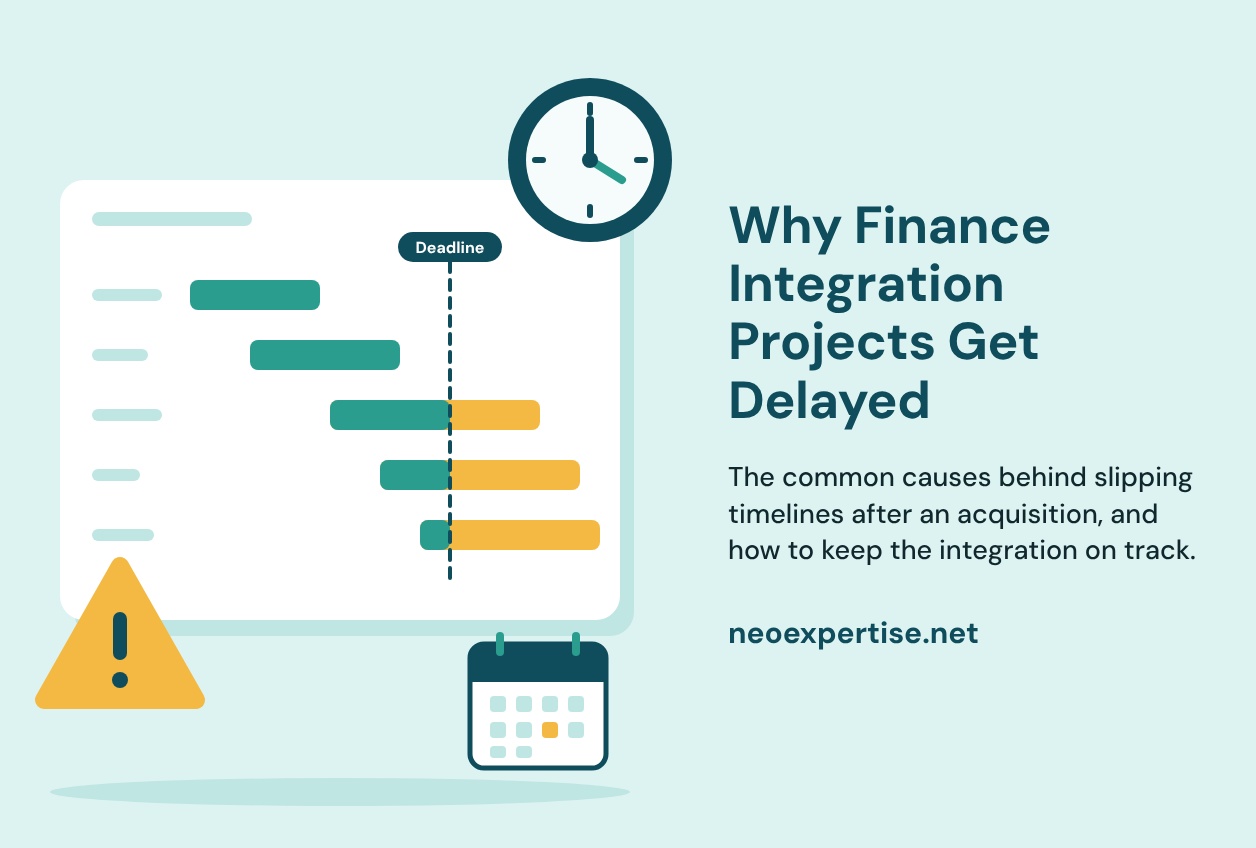
Most finance integration delays are not caused by one big surprise. They are caused by a handful of smaller, repeatable problems that each cost a week or two, and together push a three month plan into a six month one. The plan looked sound on the deal team’s slide. The timetable still slipped. This article sets out the specific reasons post-acquisition finance work falls behind, in roughly the order they bite, with the early signal for each so you can catch it before the slip compounds. The aim is a Group Finance team that can name the risk on day three rather than explain the delay on day ninety.
Key takeaways
- Finance integration delays are usually cumulative, not a single event: several one-week slips that stack.
- The two most common causes are late or incomplete opening data and missing sub-ledger detail behind control accounts.
- Each cause has an early signal you can test for in the first three weeks, before the slip compounds.
- Capacity is one cause among several, not the whole story. Adding people does not fix a missing chart-of-accounts mapping.
- Some delays are the right call. Hitting a group deadline with unsupported numbers moves the problem, it does not solve it.
In this article
What actually causes finance integration delays
A finance integration delay is a slip in the point at which the acquired company can produce reliable numbers on the Group’s reporting timetable. It is rarely one dramatic discovery. It is the accumulation of dependencies that were assumed to be ready and were not: the opening data, the people who understand it, the systems that hold it, and the decisions needed to clean it.
The useful question is not “are we behind” but “which dependency is behind, and did we test for it early”. Every cause below has a signal you can check in the first three weeks, while the acquired team is still willing and able to explain how things actually work. Catching it then costs a conversation. Catching it at the first group close costs a reporting cycle.
The seven most common causes, in order
Ordered by how often they drive the first slip, and how early the signal appears.
| Cause | Why it delays the work | Early signal to test for |
|---|---|---|
| 1. Opening data arrives late or partial | Nothing downstream can start until the trial balance and sub-ledgers at close date are in hand | You are sent the reporting pack, not the trial balance exported from the accounting system |
| 2. No sub-ledger behind the control accounts | Balances cannot be substantiated line by line, so they have to be rebuilt first | Receivables exist as one control-account total with no customer-level aging |
| 3. Key finance person leaves at close | The reasoning behind manual entries and workarounds walks out of the door | One named person answers every question about how the numbers are produced |
| 4. Local chart of accounts does not map cleanly | Mapping to the group chart stalls on accounts that hold more than one thing | A single local account mixes revenue types, or a cost sits in three places |
| 5. No monthly close, only an annual one | There is no routine to produce a month-end balance sheet, so one has to be built | The team cannot show a signed-off close for any single month |
| 6. Clean-up decisions wait on absent approvers | Write-offs, provisions and materiality calls sit unapproved while items age | No agreed materiality threshold or approval route for correcting entries |
| 7. Integration runs on top of the day job | The same people close the month and do the integration, so one gives way | No ring-fenced capacity named for the integration workstream |
Cause 1 and 2: the data itself
The single most common slip starts with the wrong file. Ask for the trial balance at close date exported directly from the local accounting system or ERP, plus the AR, AP and inventory sub-ledgers that support it. Do not accept the monthly reporting pack as a substitute. The pack is often rebuilt by hand in a spreadsheet, so it reconciles to itself and to nothing else, and you will not find that out until you try to tie a balance back to a transaction. When the sub-ledger does not exist at all, the balance is only a control-account total, and the real work is reconstructing the detail before any review can begin.
This is also where consolidation obligations start to bite. Once a group is formed, consolidated accounts have to eliminate intra-group balances and transactions, a requirement set out in the EU Accounting Directive on the annual and consolidated financial statements of undertakings. That elimination is impossible until both sides agree the intercompany position, which is why intercompany reconciliation after an acquisition so often sits on the critical path.
Cause 3 to 5: people, process and systems
When the acquired company’s finance manager leaves at closing, the delay is not the empty seat, it is the lost reasoning. Why a suspense account carries a four year old balance, why one customer is always invoiced manually, why the April figure was restated: that context is rarely written down. Capture it in week one through recorded handover sessions, not month two through reverse engineering. Where no monthly close has ever run, budget time to build the close itself before you can expect a month-end balance sheet, and sequence it against the wider first 100 days finance integration roadmap.
Cause 6 and 7: decisions and capacity
Clean-up stalls when no one can approve the fix. Set a materiality threshold and a named approver for correcting entries in week one, so a EUR 4,000 write-off does not wait three weeks for a decision that was never anyone’s job. Capacity is the seventh cause, not the first, and the distinction matters: adding two contractors does nothing if the chart of accounts still will not map or the sub-ledger still does not exist. Fix the dependency first, then size the team against what is left.
Illustrative timeline: where three months becomes six
The figures below are illustrative, not a real engagement, and are rounded for clarity. They show how three ordinary slips compound rather than add.
| Planned | What happened | Slip |
|---|---|---|
| Weeks 1 to 2: receive and review opening balances | The reporting pack arrived, not the trial balance. The real export took 3 weeks to produce. | +3 weeks |
| Weeks 3 to 6: substantiate the balance sheet | AR was a single EUR 2.1m control account with no aging. 40 open items had to be rebuilt from invoices. | +4 weeks |
| Weeks 7 to 10: clear suspense and reconcile intercompany | A EUR 180,000 suspense balance needed a write-off decision. No approver was named, so it waited. | +3 weeks |
| Weeks 11 to 12: first group close | Missed. The subsidiary reported on a 2 month lag for the first cycle. | +2 weeks |
None of these was a disaster on its own. Together they turned a 12 week plan into roughly a 24 week one, and the only one visible on day one was the first.
How to prevent the delay
Prevention is mostly front-loading the tests. Run this checklist in the first three weeks.
- Request the right artefacts by name. Trial balance at close date from the accounting system, plus AR, AP and inventory sub-ledgers. Not the reporting pack.
- Test one balance end to end on day three. Pick receivables, tie the control account to the aging to three sample invoices. If you cannot, cause 2 is live.
- Record a knowledge handover in week one with anyone who might leave, covering manual entries, suspense balances and recurring workarounds.
- Agree a materiality threshold and a named approver for correcting entries before you find the first item that needs one.
- Ring-fence integration capacity separately from the people who run the monthly close, and link the plan to what a CFO should review after an acquisition.
- Map the chart of accounts early and flag any local account that holds more than one type of item, since those are where the mapping stalls.
Serial acquirers get this down to a routine. The same tests, run the same way on every deal, is the core of a repeatable finance integration playbook for serial acquirers.
When a delay is the right call
Not every slip should be fought. There is a real difference between a timetable that is late and numbers that are wrong, and the second is worse. If the choice is reporting on time with a balance sheet you cannot support, or reporting a cycle late with one you can, the honest late number is usually the right call for the first close. Statutory deadlines are the exception that cannot move: a UK private company must file its annual accounts within 9 months of the end of its accounting reference period (Companies Act 2006, section 442), and missing that deadline triggers an automatic civil penalty that rises the later the accounts are filed. Where a statutory filing is at risk, that takes priority over the group management timetable. Everywhere else, protect the integrity of the numbers before the calendar.
Need additional finance capacity to keep an integration on track? Discuss your finance integration project with our team.
FAQ
Why do finance integration projects take longer than planned?
Because the delay is usually cumulative. Several dependencies assumed to be ready are not: opening data, sub-ledger detail, the people who understand the numbers, and the decisions to clean them. Each slips a week or two, and together they turn a three month plan into a six month one.
What is the single most common cause of finance integration delays?
Receiving the wrong opening data. Teams are sent the monthly reporting pack instead of the trial balance exported from the accounting system. The pack reconciles only to itself, so the real export has to be requested again, costing weeks before substantiation can even start.
Does adding more finance staff fix an integration delay?
Not on its own. Capacity is one cause among several. If the chart of accounts will not map to the group chart, or the sub-ledger behind a control account does not exist, more people cannot start the work. Fix the blocking dependency first, then size the team against what remains.
Is it better to hit the group deadline or report accurate numbers?
For the first close, accurate numbers usually win. A balance sheet you cannot support moves the problem into the next cycle rather than solving it. The exception is a statutory filing deadline, such as the Companies House 9 month limit, which cannot be missed and takes priority.

Brahim Rami | Member of institute of chartered accountants in Morocco
He is a CPA and tax advisor, founder of NeoExpertise.net, a Legal and Tax firm helping foreign companies with business setup, due diligence, payroll, and tax compliance in Morocco and Africa.