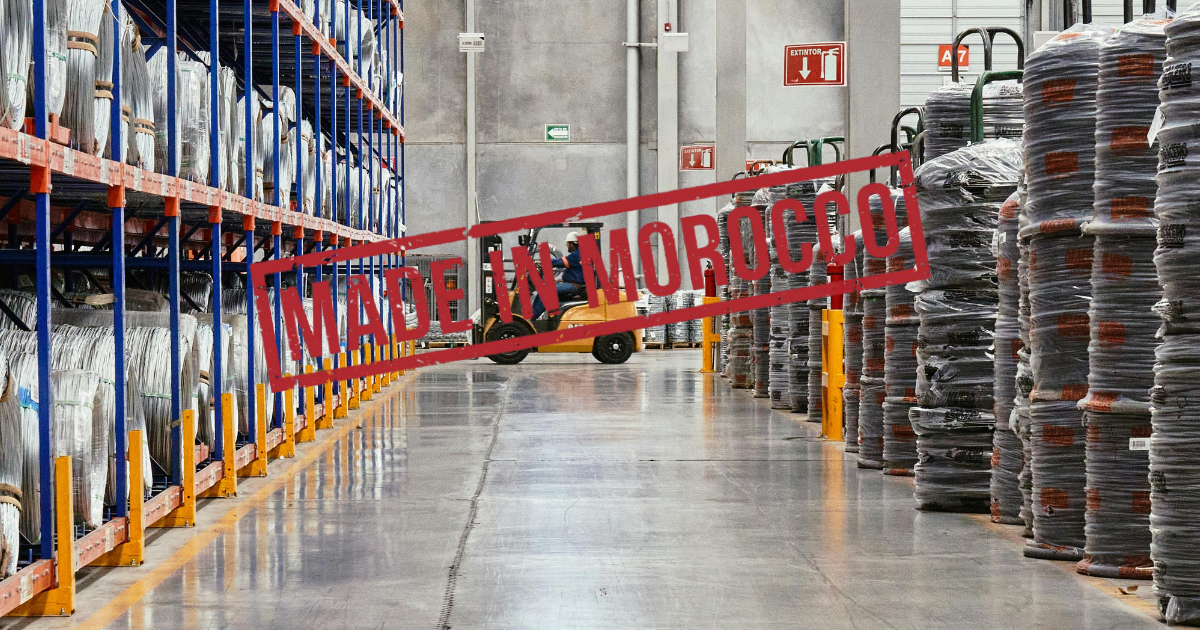
Manufacturing in Morocco
Morocco has become one of the world’s most strategic manufacturing destinations. It sits just 14 km from Spain, holds free-trade agreements with the EU, the United States, the Arab League and across Africa under the AfCFTA, and its manufacturing costs remain well below southern Europe. “Made in Morocco” is not just a quality mark — it is direct market access to hundreds of millions of consumers under preferential customs rates.
Yet the certification process is genuinely complex for foreigners. There are two separate systems, sector-specific requirements, textile origin rules that catch most newcomers off guard, and a business-registration prerequisite that most guides skip. This guide covers the full picture — and flags the points where the details decide whether you qualify.
First: understand the two systems
When people say “Made in Morocco certification,” they usually mean one of two completely different things. Understanding which one you need — or that you likely need both — is the starting point.
| System | What it is |
|---|---|
| IMANOR label | A voluntary quality and origin branding mark placed on your product and packaging. Issued by Morocco’s national standards institute after an audit of your factory. |
| Proof of origin (customs) | Documents used, shipment by shipment, so your goods are recognised as Moroccan at destination. Two kinds exist and they are not interchangeable: a non-preferential certificate of origin issued by a regional Chamber of Commerce (general proof of Moroccan origin), and preferential proof that actually unlocks the reduced duty rate under a trade agreement — a EUR.1 endorsed by Moroccan Customs (ADII) for the EU, self-certification for the US, or a Certificate of Arab Origin for the Arab League. |
Most manufacturers need both a label and origin documents. The IMANOR label goes on your product. The origin documents go in your shipping paperwork for every export — and which origin document secures the preferential rate depends on the destination market, not on the Chamber certificate alone.
The IMANOR “Made in Morocco” label
IMANOR — the Institut Marocain de Normalisation — is Morocco’s official national standards body under the Ministry of Industry and Trade. It officially launched the “Made in Morocco” industrial label in November 2025 at the National Industry Day in Rabat.
The label certifies that your product was manufactured on Moroccan territory, conforms to the applicable Moroccan quality standard (NM norm) for its category, has full traceability from raw material to finished product, and was produced under consistent, controlled conditions.
The requirement shorter guides miss. The label is not granted for simply assembling a product on Moroccan soil. Its defining condition is a minimum of 40% local value-added, or a substantial transformation carried out in Morocco. IMANOR assesses this through documentary review, an on-site inspection, and an examination of the production and value-creation process.
Who is eligible
Any producer with a legally registered Moroccan company and a physical production facility in Morocco can apply — regardless of nationality. Foreign ownership of up to 100% is permitted in most sectors. The barrier is not your passport; it is not yet having a registered Moroccan company.
You cannot apply to IMANOR as an individual foreigner. You must first register a Moroccan business entity (SARL or SA) and operate a real production facility in Morocco. See the company-registration section below.
What IMANOR checks
- Origin: is the product physically manufactured in Morocco? Verified by documentary evidence and a facility inspection.
- Local value creation: does the product reach at least 40% local value-added, or a substantial transformation in Morocco? Verified through value-chain and cost analysis.
- Conformity: does the product meet the applicable Moroccan NM standard for its category? Verified by technical-file review and lab testing where needed.
- Traceability: can you document the full chain from raw materials to finished product? Verified by supply-chain documentation audit.
- Controlled conditions: is there consistent quality management throughout production? Verified by on-site production audit.
Additional approvals required by sector
| Sector | What you also need |
|---|---|
| Food and agri-food | ONSSA health approval. FSSC 22000 certification for oil producers. |
| Cosmetics and personal care | ISO 22716 GMP certification. DMP market authorization from the Ministry of Health. |
| Textiles and clothing | NM 09.000 labeling compliance. |
| Industrial goods | PCA (Product Conformity Assessment) for regulated product categories. |
| Pharmaceuticals | Full Ministry of Health licensing. Allow up to 6 months. |
The application process, step by step
- Confirm your Moroccan company registration is valid — you need a Registre de Commerce, ICE tax number, and patente.
- Download the Cahier des Charges for your product category from imanor.gov.ma. This specification document defines exactly what you must prove.
- Prepare your application dossier — company registration documents, product technical file, evidence of Moroccan manufacturing and local value-added, NM conformity proof, and any sector-specific certificates.
- Submit to IMANOR for documentary review — evaluators review your dossier and typically request additional documents. Expect this step to take a few weeks.
- On-site facility inspection — IMANOR auditors visit your factory to verify manufacturing processes and value-chain documentation.
- Technical validation — the technical committee reviews all findings and makes the decision.
- Label attribution — IMANOR grants you the right to use the label on your products and packaging.
- Post-labeling monitoring — periodic re-audits ensure continued compliance. The label can be withdrawn if you fall out of conformity.
An incomplete dossier is the most common cause of delays. A local avocat d’affaires or an IMANOR-familiar advisor before submission is worth it. Realistic timeline: 4 to 12 weeks from complete dossier submission.
Certificates of origin — Chambers of Commerce
A certificate of origin proves to an importing country’s customs authority that your goods originated in Morocco. The one issued by a Chamber of Commerce is a non-preferential document: it establishes Moroccan origin in a general sense (useful for ordinary trade, letters of credit and some customs formalities), but it does not, on its own, secure the reduced duty rate under Morocco’s trade agreements. For that preferential rate you need the right instrument for the market: a EUR.1 for the EU, self-certification for the US, or the Certificate of Arab Origin for the Arab League (this last one is issued by the Chamber).
One-time company registration with the Chamber
Before you can request any certificates, you must register your company with the regional Chamber of Commerce covering your business location. This registration is renewed annually and requires:
- Certified copy of your Registre de Commerce
- Recent attestation d’inscription à la patente (business-tax registration)
- Certified copy of company statuts plus general-assembly minutes
- Certified copy of the manager’s CIN, or passport copy for foreign nationals
- Two recent passport-style photographs of the authorized signatory
- Specimen signature of the signatory, filed directly with the Chamber
Per-shipment application
For every export shipment, you apply online via your regional Chamber’s digital platform. You will need the commercial invoice, the Single Goods Declaration (DUM, filed in the BADR customs system), the export notification, and the packing list.
Rules of origin: what legally makes a product “Moroccan”
This section is where most foreign manufacturers are caught off guard. “Made in Morocco” is not just about location — it is a legal determination that varies depending on which country you are exporting to.
Three ways a product qualifies
- Wholly obtained: the product is 100% grown, extracted or produced in Morocco with no foreign inputs. Examples: fresh produce, phosphates, pure argan oil.
- Sufficient transformation (US FTA rule): foreign materials are processed in Morocco into a new and different article of commerce, and at least 35% of the product’s appraised value comes from Moroccan territory, including materials and direct processing costs.
- Sufficient working or processing (EU / PEM rule): the product meets the origin rule set for its specific tariff line — which, depending on the product, may be a change of tariff classification, a ceiling on the value of non-originating materials, or a specific processing operation. A simple “tariff shift” is only one of the possible tests, not the universal rule.
Which rule applies to which market
| Export market | Origin rule and proof |
|---|---|
| European Union | Product-specific rule under the Pan-Euro-Mediterranean (PEM) framework — change of tariff classification, value ceiling on non-originating materials, or a specific processing operation, depending on the product. Proof: EUR.1 movement certificate issued by ADII (Moroccan customs), or an Approved Exporter invoice declaration. |
| United States | 35% appraised-value content from Morocco and/or the US combined, or substantial transformation. Proof: self-certification by importer/exporter — there is no government-issued certificate. |
| Arab League (GAFTA) | 40% local value-added. Proof: Certificate of Arab Origin, issued by your Chamber of Commerce. |
| Agadir Agreement (Tunisia, Egypt, Jordan) | PEM rules apply. Proof: EUR.1. |
| African Union (AfCFTA) | Rules-of-origin protocol still being phased in. Morocco is a signatory — track updates before building a strategy around it. |
Germany is an exception. Germany objected to Morocco’s accession to the Hague Apostille Convention. Any documents used in German–Moroccan trade require full diplomatic legalization — not just an apostille stamp.
Textiles and clothing: the rules that catch everyone
Textiles and clothing (HS chapters 50 to 63) carry some of the strictest rules of origin globally. Morocco’s biggest textile export market is the EU, which demands more than sewing happening in Morocco.
The EU double-transformation requirement
To qualify as Moroccan origin under the EU–Morocco Free Trade Agreement, a garment typically requires two full stages of transformation, both performed in Morocco:
- Stage 1: yarn is woven or knitted into fabric in Morocco.
- Stage 2: the fabric is cut and sewn into a finished garment in Morocco.
If you import ready-made fabric and only sew it in Morocco, the finished garment does not qualify as Moroccan origin under EU preferential rules. A tolerance of 10% by weight of non-originating materials exists for most garment categories, but it does not override the double-transformation requirement.
What must appear on the garment label
| Label information | Requirements |
|---|---|
| Fiber composition (%) | Mandatory in all markets. |
| Country of origin | Mandatory in Morocco and the US (“Made in Morocco”). Not explicitly required by EU Regulation 1007/2011, but many member states require it separately. |
| Care instructions | Mandatory in Morocco and the US. Not required under EU Regulation 1007/2011 (may be required by individual member states). |
| Language | Arabic and French for Morocco. Official language of each EU country for EU sales. English for the US. |
The applicable Moroccan standard for textile labeling is NM 09.000. All products sold on the Moroccan market must comply with it.
AMITH — the Association Marocaine des Industries du Textile et de l’Habillement — is the official trade body for Morocco’s textile and clothing sector. It does not issue certifications, but provides market-access support, trade-fair participation through the annual MIM Show, and administers the voluntary “Citizen Fiber” social-responsibility label. Their website is amith.ma.
Setting up as a foreign manufacturer in Morocco
You cannot get any “Made in Morocco” certification without a registered Moroccan company. Here is what you need to know about doing that as a foreigner.
Company types available to foreigners
| Type | Key facts |
|---|---|
| SARL (Limited Liability Company) | No minimum share capital required by law — freely set by the partners. 1 to 50 partners. Most common choice for foreign small and medium manufacturers. |
| SARL-AU (Single-person LLC) | One person only. Good for a solo foreign entrepreneur starting small. |
| SA (Joint-Stock Company) | Minimum capital MAD 300,000 (MAD 3,000,000 if publicly offered). At least 5 shareholders. For larger operations or those seeking outside investment. |
| Succursale (Branch) | No minimum capital. Used by multinationals establishing a Moroccan presence. Parent company holds unlimited liability. |
Foreigners can own 100% of a SARL or SA in most manufacturing sectors. No Moroccan partner is legally required.
How to register via the CRI one-stop-shop
- Reserve your company name at OMPIC — submit at any CRI office or online. Result in 24 to 48 hours. Valid for 6 months.
- Draft your Articles of Association (Statuts) — must comply with Law 5-96 for a SARL. Notarization is required if the contribution includes property or in certain cases.
- Open a Moroccan bank account and deposit share capital — the bank issues a certificat de blocage des fonds required for registration.
- Submit your complete dossier to the CRI — it issues your Registre de Commerce, ICE tax ID, patente and CNSS social-security affiliation in a single submission. No separate agency visits.
- Publish the formation notice in a journal d’annonces légales (an authorised legal-notices newspaper) and in the Bulletin Officiel — legally required.
- Obtain any sector-specific operating licenses — ONSSA for food, DMP for cosmetics, full Ministry of Health licensing for pharmaceuticals. Allow 1 to 6 months.
The full registration process typically takes about 1 to 2 weeks (roughly 5 to 10 working days) once all documents are in order.
All documents originating outside Morocco — passports, corporate documents, diplomas — must be apostilled (for Hague Convention member countries) or embassy-legalized, and officially translated into French or Arabic by a certified sworn translator.
Need help navigating the process?
Neo Expertise guides foreign manufacturers through every step of Made in Morocco certification — from company registration to IMANOR label approval and origin-proof setup.
- Company registration (SARL/SA) via CRI, end to end
- IMANOR dossier preparation and audit support
- Certificate of origin registration with your regional Chamber
- Rules-of-origin analysis for EU, US and Arab League markets
- Sector approvals (ONSSA, DMP, PCA)
The export process from Morocco
Once your products are ready and certified, here is what each export shipment requires.
| Document | Details |
|---|---|
| Commercial invoice | Prepared by you. Must match the customs declaration exactly. |
| Packing list | Prepared by you. Detailed weights and dimensions per package. |
| Bill of Lading / Air Waybill | Issued by your shipping carrier. |
| Certificate of origin (non-preferential) | Issued by your regional Chamber of Commerce. General proof of Moroccan origin (not, on its own, the preferential-rate document). |
| EUR.1 movement certificate | Issued by ADII (Moroccan customs). Required to claim preferential EU duty rates. |
| DUM — Single Customs Declaration | Filed electronically by you in Morocco’s BADR customs system before shipment. |
| ONSSA certificate | Required for food, plant and agricultural product exports. |
| Exchange commitment | Registered with the Office des Changes via your authorized bank. Legally required for all exports. |
Moroccan law requires all export revenues to be repatriated to Morocco through an authorized bank within 150 days of the customs declaration being registered (90 days for services). Failure to comply carries significant financial penalties.
Key digital platforms
- BADR (douane.gov.ma) — Morocco’s electronic customs-declaration system, where you file your DUM.
- PortNet (portnet.ma) — the single-window platform for port logistics and conformity certificates.
Where foreign manufacturers set up
- Tanger Med & Tanger Free Zone — Africa’s leading container port and a hub for textiles, automotive and electronics; direct sea access to Europe.
- Kenitra — best for automotive and industrial components. The Atlantic Free Zone hosts major automotive manufacturers including Stellantis (formerly PSA). The regional Chamber falls under CCIS-RSK.
- Casablanca-Settat — the largest industrial and financial base, broad supplier ecosystem and logistics.
Frequently asked questions
Can a foreigner get the “Made in Morocco” label?
Yes. Any producer with a legally registered Moroccan company and a physical production facility in Morocco can apply for the IMANOR label, regardless of nationality. Citizenship is not a requirement; company registration in Morocco is — and the product must meet the label’s local value-added or substantial-transformation criteria.
What’s the difference between the IMANOR label and a certificate of origin?
The IMANOR label is a quality and origin mark that goes on your product packaging, obtained once after a factory audit. A certificate of origin is a customs document tied to export shipments. Note that the Chamber-issued certificate is non-preferential — the document that unlocks a lower duty rate is the EUR.1 (EU), self-certification (US) or Certificate of Arab Origin (Arab League). Most manufacturers need both a label and the right origin proof.
What percentage of local content is required for “Made in Morocco”?
It depends on the purpose. The IMANOR label looks for at least 40% local value-added or a substantial transformation. The US–Morocco FTA uses a 35% appraised-value test. EU rules are set product by product. Products made entirely from Moroccan materials qualify under any agreement — but few industrial products are.
How long does it take to get the IMANOR label?
IMANOR does not publish a fixed timeline. A realistic estimate is 4 to 12 weeks from complete dossier submission, depending on the product category and how quickly the on-site inspection is scheduled.
Do I need to speak Arabic or French?
All official Moroccan documents must be in Arabic or French. You can use a certified sworn translator for foreign documents and a local avocat d’affaires to manage applications on your behalf. Most CRI offices and IMANOR in major cities have English-speaking staff.
Can I label clothes “Made in Morocco” if the fabric is imported?
For the Moroccan domestic market, substantial cutting and sewing in Morocco is generally accepted. For EU export under preferential rates, sewing imported fabric does not satisfy the double-transformation requirement, so the EU–Morocco FTA rate will not apply. For the US, if your cutting, sewing, trimming and Moroccan overhead reach 35% or more of final value, it can qualify under the US–Morocco FTA.
Can I manufacture in a free zone and still get the label?
Yes. Free zones such as the Tanger Free Zone are on Moroccan sovereign territory, so manufacturing there qualifies as Moroccan production for IMANOR purposes, and products exported directly from a free zone carry Moroccan origin status — though the interaction with incentives and origin proof has specifics worth confirming for your case.
Is the IMANOR label recognised in Europe and the US?
It is a Moroccan national quality and origin mark. It is not a substitute for EU CE marking or US FTC/FCC requirements. It signals compliance with Moroccan NM standards and Moroccan origin, and complements importing-country requirements without replacing them.
What happens if IMANOR withdraws the label after I have it?
IMANOR conducts periodic post-labeling audits. If your products or processes no longer meet the criteria — for example after a change of supplier or production method — IMANOR can suspend or withdraw the label. You cannot use it during suspension and must complete a new full application and audit to reinstate it.
Final checklist
- Register a Moroccan company (SARL or SA) via the CRI one-stop-shop — takes about 1 to 2 weeks
- Open a Moroccan business bank account and deposit your share capital
- Register your authorized signatory’s specimen signature with your regional Chamber of Commerce
- Obtain any sector-specific approvals — ONSSA for food, DMP for cosmetics, Ministry of Health for pharmaceuticals
- Ensure your production facility is physically in Morocco with full manufacturing documentation
- Download the IMANOR Cahier des Charges for your product category from imanor.gov.ma
- Build and submit your IMANOR dossier; await documentary review then on-site audit
- Ensure labels comply with NM 09.000 (Moroccan market) or EU Regulation 1007/2011 (EU export)
- Register as an exporter in the BADR customs system at douane.gov.ma
- Register your exchange commitment with the Office des Changes via your authorized bank
- For each shipment: file the DUM via BADR and obtain a certificate of origin from your Chamber
- For EU exports: obtain a EUR.1 movement certificate from ADII customs
- Repatriate export revenues within 150 days of the customs declaration being registered
- Schedule your annual IMANOR post-labeling compliance review
Ready to get your “Made in Morocco” certification?
The process spans multiple agencies, strict dossier requirements and sector-specific rules that change with your export market. Neo Expertise has guided foreign manufacturers through every stage — from choosing the right structure to passing the IMANOR audit and setting up export documentation.
- Full certification roadmap tailored to your product and target market
- IMANOR dossier preparation and audit accompaniment
- Certificate of origin and EUR.1 setup with your regional Chamber and ADII
- Rules-of-origin review for EU, US and Arab League compliance
- Sector approvals: ONSSA, DMP, PCA