Table Of Contents
- Why Start a Business in Morocco in 2026?
- Can Foreigners Start a Business in Morocco?
- What is AML Compliance in Morocco?
- Types of Business Structures in Morocco
- The 12 Steps to Registering a Company in Morocco
- Registration Timeline and Costs
- Ongoing Compliance Obligations After Company Registration in Morocco
- Special Economic Zones and Incentives
- Hidden Costs and Common Mistakes Foreign Investors Make
- Navigating Common Challenges: Practical Solutions
- Morocco vs. Other North African Markets: Where It Actually Stands
- Frequently Asked Questions
- How Neo Expertise Helps You Structure It Properly From Day One
- Related insights
If you are researching how to start a business in Morocco, the short answer is this: yes, foreigners can own 100 percent of a company in most sectors, the process is centralized through the Regional Investment Centers, setup usually takes between 3 and 7 days if structured correctly,and total incorporation costs typically depend on complexity.
The long answer is what this guide covers.
Starting a company in Morocco is not difficult. But structuring it correctly, planning tax exposure, understanding banking compliance, and anticipating regulatory requirements in 2026 requires preparation. This guide walks you through the legal structures, step by step registration process, full cost breakdown, tax system, foreign investor rules, and common mistakes most entrepreneurs only discover after they have already incorporated.
If you are serious about investing in Morocco, read this carefully.
Why Start a Business in Morocco in 2026?
Morocco has positioned itself as a strategic gateway between Europe and Africa.
Morocco has signed more than 55 bilateral and multilateral trade agreements, including the EU-Morocco Association Agreement. (Source: Moroccan Ministry of Industry and Trade, 2024) , strong infrastructure such as Tangier Med Port, and growing industrial ecosystems, the country attracts manufacturers, service companies, tech startups, and holding structures.
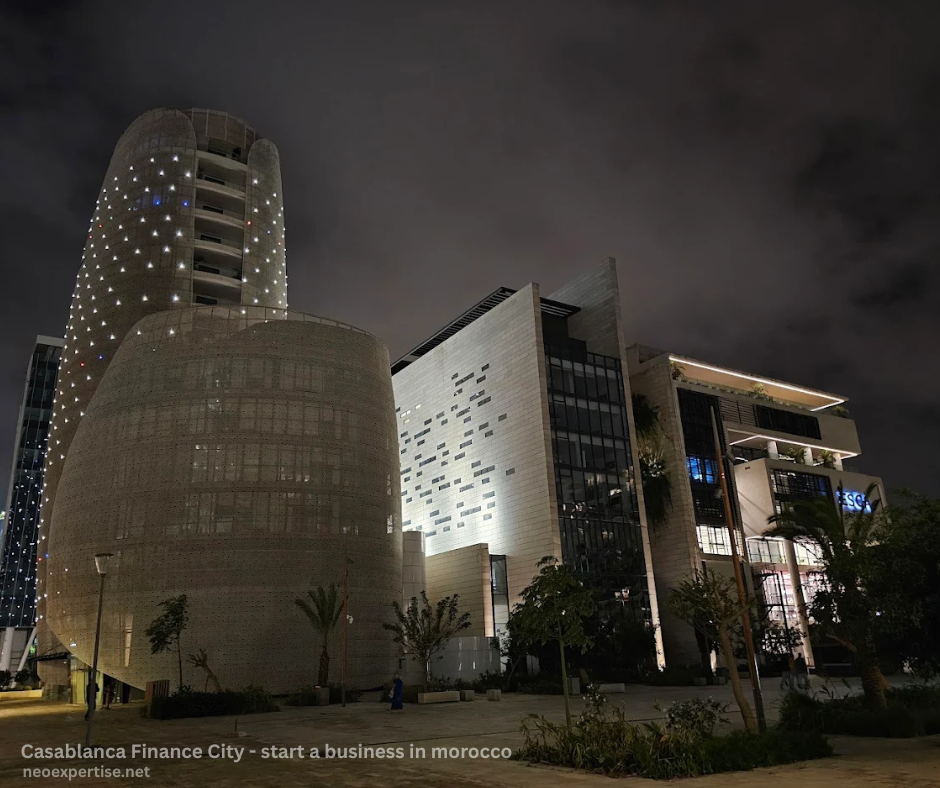
GDP growth is projected at 3.2% for 2026, driven by renewable energy, automotive manufacturing, and digital services. (Source: IMF World Economic Outlook, October 2025), driven by renewable energy, automotive, agribusiness, tourism, and digital services. Casablanca remains the financial hub, while Tangier and Kenitra dominate industrial production. Casablanca Finance City offers a special regime for financial and export-oriented services.
Can Foreigners Start a Business in Morocco?
Yes. Foreign investors can fully own a Moroccan company in most sectors.There is no requirement for a Moroccan partner in general commercial, industrial, consulting, tech, trading, or service activities. However, some sectors such as agriculture, certain media activities, and regulated industries may require additional approvals or partnership structures.
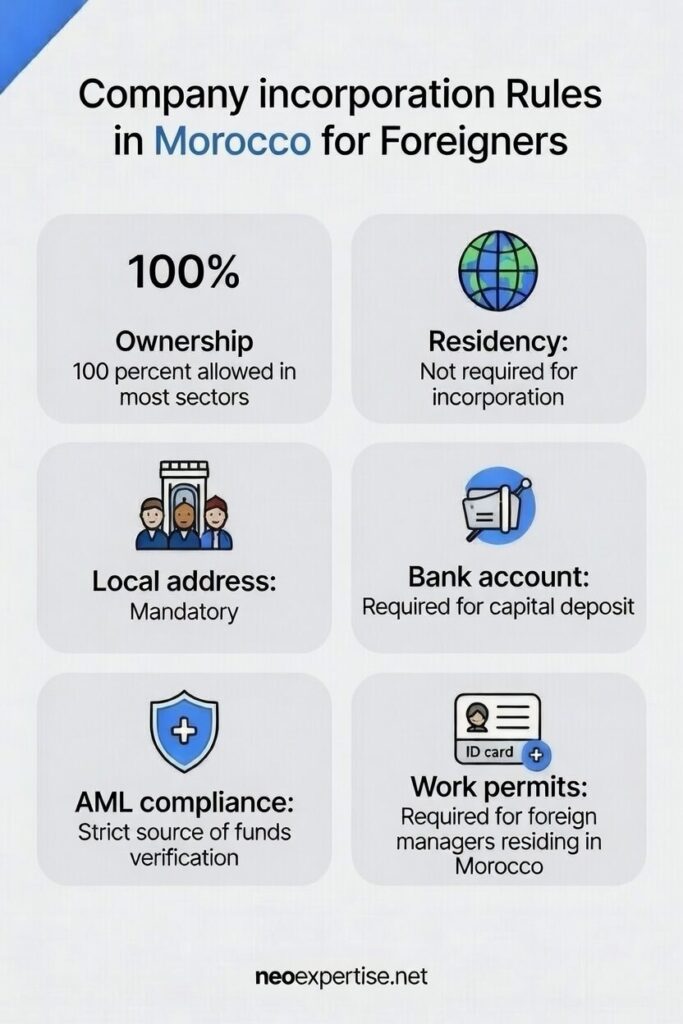
Foreign Investor Snapshot 2026
- Ownership: 100 percent allowed in most sectors
- Residency: Not required for incorporation
- Local address: Mandatory
- Bank account: Required for capital deposit
- AML compliance: Strict source of funds verification
- Work permits: Required for foreign managers residing in Morocco
Foreigners can incorporate remotely through a representative. Residency becomes relevant only if you plan to live in Morocco long term and apply for a residence card.
What is AML Compliance in Morocco?
AML (Anti-Money Laundering) compliance requires foreign investors to document the legal origin of capital deposited for company formation. Banks must verify funds are traceable
to declared professional or business income under Bank Al-Maghrib Circular 2/W/2019.
What the Investment Charter of 2022 Guarantees Foreign Investors
Lorocco’s updated Investment Charter isn’t marketing material—it creates legally enforceable protections for foreign investors.
- Complete Ownership Control
Foreign nationals can hold 100% of company capital in all unrestricted sectors. No local partner required. No hidden ownership caps. - Unrestricted Profit Movement
After settling tax obligations, you can repatriate profits, dividends, and capital gains in foreign currency without bureaucratic interference. - Equal Legal Standing
Foreign-owned companies enjoy identical rights to domestic firms for government procurement, licensing approvals, and commercial dispute resolution. - Performance-Linked Incentives
The Charter ties benefits to actual investment. Projects exceeding 500 million MAD or creating 500+ jobs qualify for premium grant support. Smaller investments access tiered incentives based on sector priority and regional location. - International Arbitration Access
Bilateral investment treaties give foreign investors recourse to international arbitration mechanisms, bypassing potential domestic court delays.
Types of Business Structures in Morocco
Limited Liability Company (SARL – Société à Responsabilité Limitée)
Morocco’s limited liability company. One shareholder minimum. No legal capital floor—banks expect around 10,000 MAD. Managers can be non-residents. Limited liability, flexible governance. The standard choice for foreign SMEs and trading companies.
Public Limited Company ( SA- Société Anonyme)
Choose SA if raising external capital, issuing shares, or planning a stock exchange listing. Requires 300,000 MAD minimum capital and stricter governance. Overkill for most foreign investors.
Branch Office (Succursale)
Branches suit temporary market testing. No separate legal entity, no capital requirements. Parent company retains full liability. Most advisors recommend SARL instead for long-term operations.
Sole Proprietorship (Entreprise Individuelle)
the simplest structure. One person owns and manages everything. No capital requirements.Unlimited personal liability—your assets cover business debts. Simple accounting, lower costs.Best for freelancers, consultants, small retailers. Not suitable for riskier ventures or external investment.
Representative Office (Bureau de Liaison)
Market research and promotion only. No commercial activity, revenue, or contract signing.Useful for exploring opportunities before committing. Lower compliance burden than operational structures.Must still register and file annual reports. Temporary stepping stone, not a long-term solution.
The 12 Steps to Registering a Company in Morocco
The process is centralized through the Regional Investment Centers. Many steps are digital in 2026.
Step 1: Choose Your Legal Structure
Pick the legal form that matches how you’ll actually operate, weighing liability protection, capital requirements, and the number of partners. The choice shapes your tax treatment, compliance obligations, and operational flexibility , so consult a Moroccan lawyer or accountant if it isn’t obvious.
Step 2: Reserve the Company Name
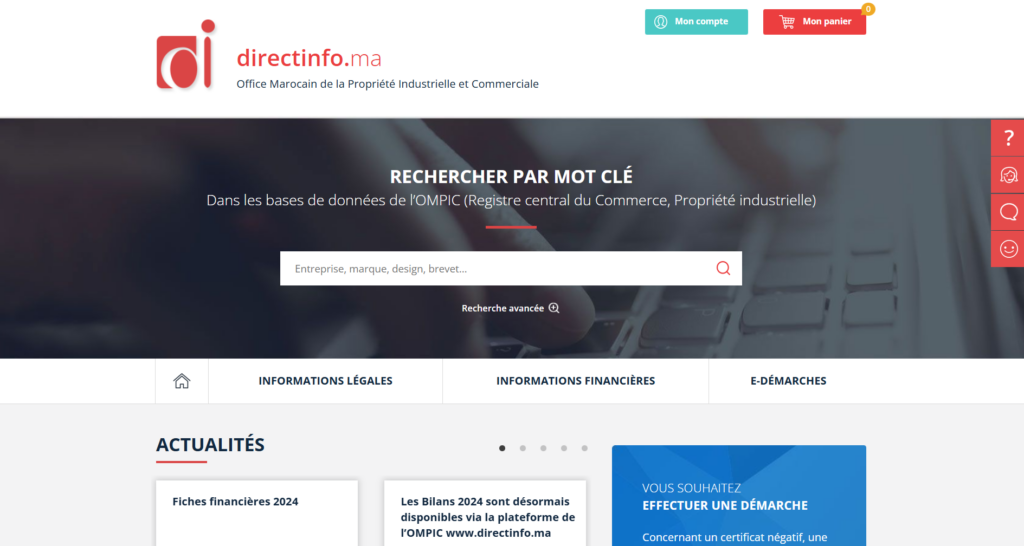
Check your desired name against the Moroccan Commercial Register (OMPIC), it must be distinct, not identical or too similar to an existing company. File the reservation with the Regional Investment Center (CRI) or through the online portal, approval takes 24 to 48 hours, and the name is then held for six months. Protected terms like “Royal,” “National,” or “Bank” require specific authorization.
Step 3: Prepare Required Documents
Requirements vary by structure, but most files are built from the same core set.
In every case:
- Copies of the founders’ national ID cards or passports
- Proof of the registered office address (lease agreement or property deed)
- Company statutes (articles of association)
- Bank certificate confirming the capital deposit
Additionally, for foreign investors:
- Passport copies, notarized and apostilled
- Proof of address in the home country
- Home-country registration documents, where a shareholder is itself a company
Anything issued abroad must be translated into French or Arabic by a certified translator.
Step 4: Draft the Articles of Association
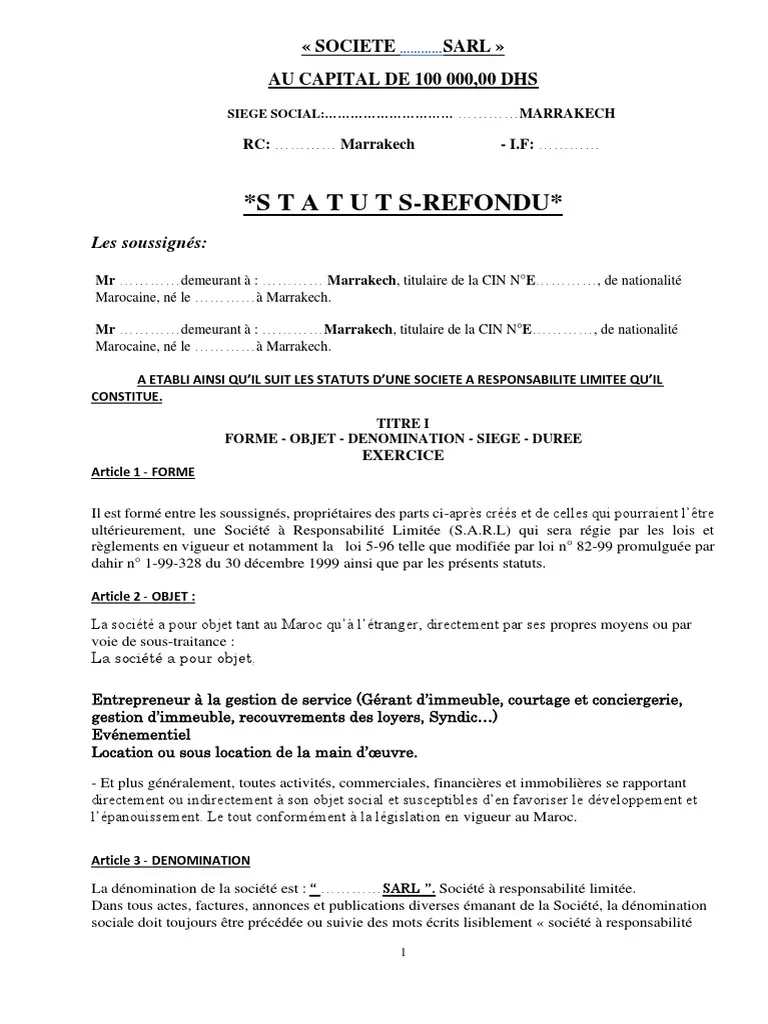
Your statutes (articles of association) define the company’s structure, governance, and operating rules. They must state the company name, registered address, business purpose, share capital, and management structure, along with each shareholder’s rights and obligations. Use a standard CRI template or have a lawyer draft them — either way, they must be notarized before filing.
Step 5: Deposit Share Capital
Open a blocked account at any Moroccan bank and pay in the minimum capital your structure requires. The bank issues a certificate of deposit (certificat de blocage) as proof. The funds stay frozen until you hand the bank your commercial registration certificate, after which they’re released for business use.
Step 6: Notarize Company Documents
Your statutes must be authenticated before they can be filed either by a notary (notaire) or legalized at the local administrative office. Whoever handles it will confirm the identity of every founder and witness and check the documents for legal compliance. Founders must appear in person, or be represented by someone holding a notarized power of attorney.
Step 7: Register with the Commercial Court
File your application with the Commercial Court (Tribunal de Commerce) covering the city where the company will be based, either at the counter or online through the Moroccan Business Center portal. You’ll submit:
- The notarized company statutes
- The bank certificate of capital deposit
- Proof of the registered office
- Founders’ identification documents
- Completed registration forms
The court reviews the file and issues your commercial registration number (Registre de Commerce), typically within 3 to 7 business days.
Step 8: Publish the Legal Announcement
The company’s formation must be made public in two steps: a legal notice in a Moroccan newspaper approved to carry such announcements, then publication in the Official Bulletin (Bulletin Officiel). The notice sets out your company name, legal form, registered address, share capital, and management details, placing the company on the public record. Expect to pay 500 to 1,500 MAD (roughly $50 to $150), depending on the newspaper and the length of the notice.
Step 9: Obtain Your Tax Identification Number
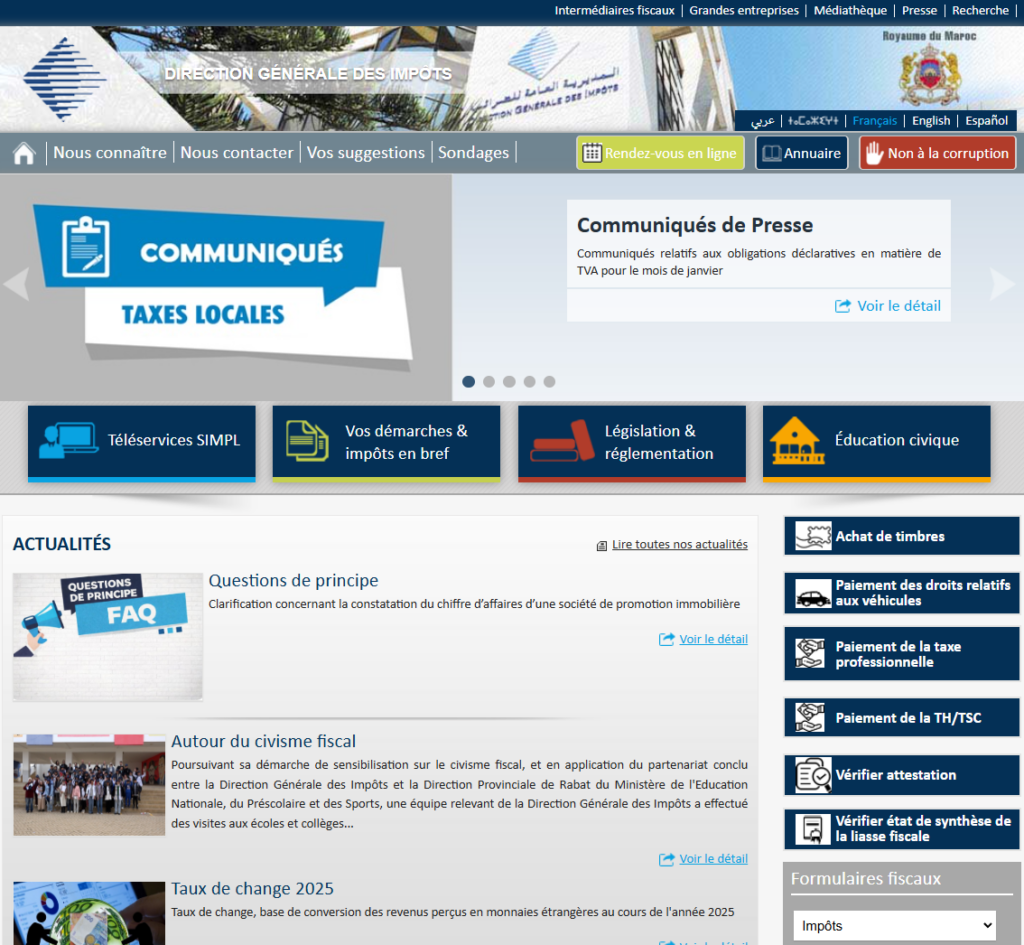
Register with the tax authorities (Direction Générale des Impôts) at your local tax office or through the CRI to obtain your tax identification number (Identifiant Fiscal). Bring your commercial registration certificate, company statutes, and founders’ identification; the number is issued immediately or within 24 hours. You’ll need it for every tax filing, invoice, and banking operation, so keep it secur, it’s your company’s primary tax identifier.
Step 10: Register for Social Security
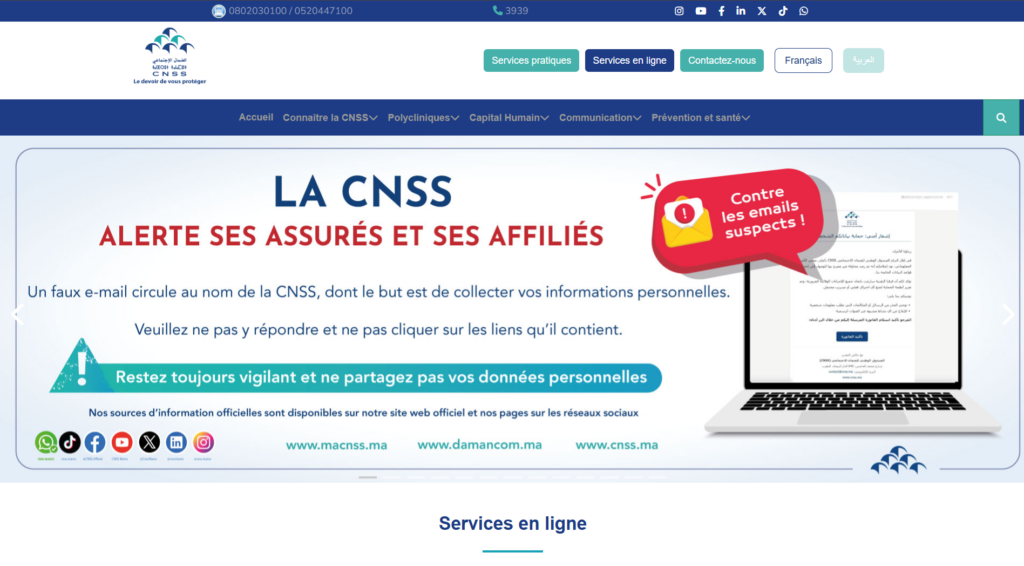
Enroll the company with the National Social Security Fund (CNSS) if you plan to hire — mandatory even before you take on your first employee. Submit your commercial registration certificate, tax ID, and company statutes, and the CNSS assigns an employer registration number (numéro d’affiliation). Each new hire must then be registered within 15 days of their start date, and contributions are compulsory for every employee in Morocco.
Step 11: Obtain Professional Licenses (If Required)
Regulated sectors, healthcare, education, food service, transport, financial services — need a specific license or permit on top of your registration. Check with your CRI or the relevant professional body, and secure any authorization before you start trading. Requirements and approval times vary widely: some licenses hinge on inspections, professional qualifications, or a higher minimum capital.
Step 12: Register for Value Added Tax (VAT)
VAT registration (TVA) becomes compulsory once annual turnover passes 500,000 MAD (about $50,000) for services or 2,000,000 MAD (about $200,000) for goods. You can also register voluntarily below those thresholds, which lets you recover input VAT on business expenses. Send the registration form to your local tax office with your commercial registration and tax ID, processing takes about 5 business days.
Registration Timeline and Costs
Expected Timeline
In normal conditions, the complete registration process runs 7 to 10 business days. That assumes your file is properly prepared and correctly submitted from the start.
Name reservation accounts for 1 to 2 days. Document preparation and notarization take another 2 to 3 days. Commercial Court registration takes 3 to 7 days.
Delays tend to happen when documents are incomplete, need corrections, or when you file during a busy period. Working with experienced professionals is the simplest way to avoid them.
Registration Costs
Total costs depend on your business structure and its complexity.
Typical cost items:
- Commercial Court registration
- Notary fees
- Legal publication
- Translation services, where required
- Professional service fees
None of this includes your share capital, which must be deposited but remains your company’s money. Professional service providers can handle the entire process for a flat fee.
Ongoing Compliance Obligations After Company Registration in Morocco
Annual Filing
Tax returns, financial statements, and statistical filings converge three months after your fiscal year closes. Public companies face additional quarterly disclosure requirements. Miss these windows, and penalties accumulate fast typically 10% of tax due plus interest.
Build a compliance calendar with hard deadlines and soft internal targets two weeks earlier. Buffer time prevents last-minute scrambles when documentation gaps emerge.
Corporate Changes
Shareholder shifts, director appointments, address moves, or activity pivots all trigger 30-day filing windows with the Commercial Court. Tax and social security records need simultaneous updates. Major structural changes—capital increases, mergers, form conversions—require shareholder votes, notarial acts, and official publication.
Handle these promptly. Delays complicate banking relationships and can invalidate insurance coverage or contract standing.
Employment Obligations
oroccan labor law heavily favors employee protection. Written contracts are mandatory for engagements beyond six months, with specific requirements for detailing compensation, role scope, hours, and termination conditions.
The CNSS contribution burden runs approximately 21% of gross payroll employer share is 16%, employee contribution 5%. Labor inspections are frequent and thorough. Maintain impeccable files: contracts, social registrations, payroll records, performance documentation. Termination without proper process triggers expensive wrongful-dismissal exposure.
Record Retention
Keep records for at least ten years, including accounting books, tax filings, bank statements, contracts, and receipts. Digital records are acceptable if they remain authentic, secure, and accessible. Organize them by fiscal year and maintain reliable backups. Missing records during an audit may lead to penalties or adverse tax consequences.
Manufacturing and Industrial Operations
Morocco has aggressively developed industrial capacity, particularly in automotive, aerospace, electronics, and textiles. Tangier Med Port and the Atlantic free zones offer genuine logistical advantages for export-oriented production.
Specific Requirements:
- Environmental permits: Required for any industrial activity with emissions, waste, or chemical processing. Timeline: 4–12 weeks depending on complexity.
- Safety certifications: ISO standards often required for supplier relationships with European manufacturers.
- Quality standards compliance: Automotive and aerospace suppliers must meet sector-specific certifications (IATF 16949, AS9100).
- Professional licenses: Certain industrial activities require licensed engineers or certified technicians on staff.
Financial Advantages:
- Access to Fonds de Promotion de l’Investissement (FPI) grants for industrial equipment
- Special financing programs through Société Générale Marocaine de Crédits et de Dépôts (SGMCD) for export-oriented manufacturers
- Export support services through Maroc Export and sector-specific associations
Services, Consulting, and Technology
Service businesses face lighter regulatory entry requirements but encounter different operational constraints.
Regulatory Landscape:
- Minimal licensing: General consulting, IT services, and marketing require no sector-specific permits beyond standard registration.
- Professional qualification requirements: Legal services, accounting, engineering, and healthcare require practitioners to hold Moroccan qualifications or membership in recognized professional bodies. Foreign credentials typically require equivalency recognition or partnership with licensed local professionals.
- Data protection: Technology companies processing personal data must comply with Law 09-08 on data protection, including registration with the Commission Nationale de Contrôle de la Protection des Données à Caractère Personnel (CNDP).
Market Access:
Service companies benefit from Morocco’s growing domestic market and can serve African and European clients from a Moroccan base. Casablanca Finance City specifically targets regional headquarters functions, offering tax advantages for service companies managing operations across multiple African markets.
Retail and E-commerce
Retail operations combine physical compliance requirements with increasingly complex digital obligations.
Physical Retail Requirements:
- Commercial premises: Must meet health and safety standards verified by local authorities before opening.
- Food retail: Requires Ministry of Health approval and regular inspection compliance.
- Lease registration: Commercial leases must be registered with tax authorities within 30 days—unregistered leases are inadmissible as tax deductions.
E-commerce Specifics:
- Consumer protection compliance: Mandatory clear pricing, published return policies, and complaint handling procedures.
- Payment processing: Online payment systems require partnership with Bank Al-Maghrib-licensed payment service providers.
- VAT obligations: E-commerce VAT collection and reporting follow strict timelines. Point-of-sale systems must integrate with Direction Générale des Impôts (DGI) requirements for electronic invoicing.
Real Estate Development
Real estate carries the heaviest regulatory burden of any sector, with multi-layered approval requirements and foreign ownership restrictions.
Regulatory Complexity:
- Zoning compliance: Projects must align with Plan d’Aménagement et d’Urbanisme (PAU) local zoning regulations.
- Construction permits: Required before any ground-breaking; large projects need environmental impact assessments.
- Utility approvals: Water, electricity, and sanitation connections require separate negotiations with ONEE and local utilities.
- Land Registry: All transactions require notarized deeds and registration with the Conservation de la Propriété Immobilière.
Foreign Investment Restrictions:
Foreign investors can purchase commercial property freely but face restrictions in certain zones—particularly agricultural land and border regions. Due diligence on property titles is essential: land registry records may not reflect informal transfers or historical claims. Always conduct independent title verification through a notaire or qualified legal advisor.
Special Economic Zones and Incentives
Morocco operates a number of free zones offering favorable tax and customs treatment. The main ones include:
- Tangier Free Zone
- Casablanca Finance City
- Industrial zones spread across several cities
Companies established in a free zone benefit from:
- A full tax exemption for their first five years, followed by reduced rates
- Simplified customs procedures
- Exemption from import duties
Each zone is built around specific sectors such as manufacturing, logistics, financial services, or technology. Companies must meet minimum investment and employment thresholds to qualify.
Investment Incentives
Tax holidays and other incentives are available for investment in priority sectors, notably renewable energy, automotive, aerospace, electronics, and technology.
New manufacturing companies can be exempted from corporate tax during their first five years of activity, while export-oriented businesses benefit from reduced rates over the long term.
Regional incentives are designed to spread development beyond the major cities. Investing in a less developed region opens access to additional tax advantages and subsidies.
Casablanca Finance City (CFC)
Casablanca Finance City is a dedicated financial hub aimed at financial services firms, regional headquarters, and professional service providers, combining attractive tax treatment with simplified procedures.
Companies holding CFC status benefit from substantial corporate income tax reductions over five years, followed by a permanently reduced rate. Foreign employees are also granted special tax treatment.
Eligibility depends on meeting minimum investment, employment, or turnover requirements. CFC status additionally opens access to Morocco’s extensive network of tax treaties.
Hidden Costs and Common Mistakes Foreign Investors Make
Most problems arise from poor preparation.
Choosing the Wrong Structure
The SARL is the default for most foreign investors, but it is not always the right answer. A company planning to issue shares, attract investors, or list on the Casablanca Stock Exchange should incorporate as an SA from day one.
Restructuring later triggers notarial fees, tax assessments on capital transfers, and banking complications that cost significantly more than getting the structure right at the start.
Ignoring AML Source of Funds
Bank Al-Maghrib Circular 2/W/2019 requires banks to verify the legal origin of any capital deposited for company formation. Foreign investors who transfer funds without supporting documentation tax returns, audited accounts, sale contracts, or inheritance records face account freezes and delays that can stretch incorporation from 7 days to 3 months. Prepare a complete capital origin file before initiating any bank contact.
Underestimating Translation and Legalization
Foreign shareholders must provide apostilled identification, translated articles of association, and in some cases notarized powers of attorney. EU documents are generally handled under the Hague Apostille Convention. Documents from non-Hague countries require full consular legalization.
Not Planning VAT and Activity Code from Day One
Morocco’s DGI assigns a professional activity code (code d’activité) at registration. This code determines VAT obligations, sectoral tax regimes, and eligibility for certain incentives. An incorrect activity code does not just cause administrative friction — it can disqualify the company from free zone benefits or trigger unexpected VAT declarations. Review activity codes with a tax advisor before submitting to the CRI.
Banking Delays from Incomplete Files
Opening a permanent corporate account in Morocco typically takes 2–4 weeks after incorporation if all documents are in order. Missing a single document — a certified copy of statutes, a translated power of attorney, or a missing utility bill for the registered address — restarts the process. Build the complete banking file before approaching any bank.
Hidden Recurring Costs to Budget For
Beyond incorporation, plan for:
- Annual accounting and tax filing: depending on transaction volume
- Annual legal announcements (if required).
- CNSS employer contributions: 21.09% of gross salary per employee
- Professional tax (patente): 10% of annual rental value of business premises
- E-invoicing software subscription: 3,000–12,000 MAD per year
Navigating Common Challenges: Practical Solutions
Every foreign investor encounters friction points. The difference between successful and stalled operations often comes down to anticipating these challenges and building solutions into your setup process.
Language and Documentation Barriers
The Challenge: Official procedures operate in French and Arabic. English proficiency is growing in the private sector but rare in government offices and legal documentation.
The Solution:
- Engage a bilingual lawyer or business consultant for registration and ongoing compliance not as an optional luxury, but as operational infrastructure.
- Use certified translators for all official documents; informal translations are not accepted for legal filings.
- Build French or Arabic capacity into your local team structure for day-to-day operations.
Regulatory Navigation
The Challenge: Moroccan regulations evolve as the government modernizes procedures. Requirements change, and published guidance often lags behind actual practice.
The Solution:
- Work with local professionals who track regulatory developments in real time.
Commercial Real Estate
The Challenge: Commercial leasing in Morocco differs significantly from Western norms. Tenant rights, renewal conditions, and exit clauses require careful negotiation.
The Solution:
- Use a real estate agent specializing in commercial properties—residential agents often lack commercial expertise.
- Have lease agreements reviewed by a lawyer before signing; standard templates often favor landlords heavily.
- Consider serviced offices or coworking spaces initially to reduce commitment while learning local market dynamics.
Banking and Capital Access
The Challenge: Account opening and financing take time. Banks require extensive documentation and operate on relationship-based service models unfamiliar to international investors.
The Solution:
- Research banks before selection; international banks with Moroccan branches (Attijariwafa Bank, BMCE ..) offer smoother international transfer capabilities.
- Prepare complete AML documentation before any bank contact—source of funds verification is non-negotiable under Bank Al-Maghrib Circular 2/W/2019.
- Build relationships with bank managers; personal relationships accelerate service quality and credit access.
Cultural Integration
The Challenge: Moroccan business culture prioritizes personal relationships and trust-building. Decision-making timelines often exceed Western expectations.
The Solution:
- Invest time in relationship-building with partners, suppliers, and authorities before expecting transactional efficiency.
- Show respect for local customs understanding Ramadan schedules, prayer times, and social protocols demonstrates seriousness.
- Build patience into project timelines; rushing relationship-building often backfires and extends timelines further.
Morocco vs. Other North African Markets: Where It Actually Stands
Morocco vs. Tunisia: Speed vs. Cost
Tunisia offers lower labor costs and competitive tax rates, particularly in offshore sectors. However, registration takes two to four times longer than Morocco, and infrastructure gaps—especially outside Tunis—add operational friction. Tunisia suits cost-sensitive manufacturing with local market focus. Morocco wins when supply chain speed, logistics reliability, and export efficiency matter more than marginal labor savings.
Morocco vs. Egypt: Market Size vs. Structure
Egypt’s domestic market of 100+ million consumers dwarfs Morocco’s 37 million. For businesses prioritizing local consumption over export, Egypt presents obvious volume advantages. However, Egypt’s legal framework—rooted in different traditions—creates friction for European investors accustomed to civil law structures. Banking compliance and currency convertibility pose ongoing challenges. Morocco offers more predictable operations, cleaner profit repatriation, and legal familiarity for European and French-speaking investors.
Morocco vs. Algeria: Openness vs. Resources
Algeria’s hydrocarbon wealth and large domestic market attract specific sector players. But foreign investment faces structural barriers: majority local ownership requirements, bureaucratic opacity, and extended registration timelines. Morocco’s liberal foreign investment code, 100% ownership allowance, and digitized registration process create a lower-friction entry point for most sectors. Algeria only competes if your business model specifically requires access to Algerian natural resources or state contracts.
The Strategic Bottom Line: Morocco does not win on every metric. It wins on the combination of speed, stability, and access. If your business model depends on exporting to Europe, serving African markets, or maintaining predictable operations, Morocco typically outperforms regional alternative
Frequently Asked Questions
How long does it take to start a business in Morocco?
Typically 3 to 7 days if documents are complete.
Can I start remotely?
Yes, through a legal representative.
What is the corporate tax rate in Morocco in 2026?
Morocco’s corporate income tax applies at graduated rates: 20% on profits up to 300,000 MAD; 22.75% between 300,001 and 1,000,000 MAD; 26.5% between 1,000,001 and 5,000,000 MAD; and 31% above 5,000,000 MAD. Free zone companies pay 0% for the first 5 years. VAT is 20% standard rate, mandatory above 500,000 MAD annual turnover.
What is the minimum capital?
No strict legal minimum for SARL, but banks often expect around 10,000 MAD.
What taxes will my company pay?
Corporate tax between 20 and 31 percent, VAT 20 percent, plus social contributions if hiring employees.
Can foreigners own 100% of a company in Morocco?
Yes. Foreign investors can own 100% of a Moroccan company in most sectors.
Is electronic invoicing mandatory in Morocco in 2026?
Yes. E-invoicing became mandatory for certain businesses in Morocco in 2026 as part of the DGI digital compliance rollout.
What is the minimum capital required to start a SARL in Morocco?
There is no minimum capital requirement for a SARL in Morocco as of 2026. However a capital deposit at a Moroccan bank is required during registration.
What is Casablanca Finance City and who qualifies?
Casablanca Finance City (CFC) offers preferential 15% flat corporate tax for eligible financial services, holding companies, and regional headquarters.
Do I need a Moroccan partner to start a business in Morocco?
No. Foreign nationals can own 100% of a Moroccan company in most commercial, industrial, consulting, and technology sectors without a local partner. Exceptions apply in agricultural land, certain media activities, and some financial services requiring Bank Al-Maghrib approval. The Investment Charter of 2022 guarantees full ownership and profit repatriation rights.
What is the difference between a branch and a subsidiary in Morocco?
A branch has no separate legal personality and the foreign parent bears full liability. A subsidiary is an independent Moroccan legal entity with limited liability. Most advisors recommend the subsidiary SARL structure for long-term operations due to greater liability protection, easier banking access, and better tax structuring options.
How Neo Expertise Helps You Structure It Properly From Day One
Starting a business in Morocco is procedural.
Structuring it correctly is strategic.
Many investors can complete registration alone. Fewer understand how to:
- Choose the optimal legal form based on future expansion
- Structure shareholding for tax efficiency
- Align activity codes with long-term business plans
- Prepare capital documentation to avoid AML delays
- Anticipate VAT and corporate tax impact before the first invoice
- Integrate e-invoicing compliance from the start
- Evaluate free zone vs standard regime vs CFC status
This is where Neo Expertise operates differently.
Neo Expertise is not a document filing service.
It is a strategic advisory partner for foreign investors entering Morocco.
We assist with:
- Pre-incorporation structuring
- Legal form selection and governance design
- Tax modeling and scenario planning
- CRI coordination and compliance supervision
- Bank preparation and capital documentation
- Free zone and incentive eligibility analysis
- Ongoing tax and regulatory alignment
Instead of simply registering your company, we ensure it is structured to scale, compliant from day one, and aligned with your international objectives.
Because in Morocco, the real risk is not starting a business.
The real risk is starting it incorrectly.

Brahim Rami | Member of institute of chartered accountants in Morocco
He is a CPA and tax advisor, founder of NeoExpertise.net, a Legal and Tax firm helping foreign companies with business setup, due diligence, payroll, and tax compliance in Morocco and Africa.
Related insights
- Can You Really Create a Company in Morocco in 7 Days?
- Morocco Business Setup for Americans and Europeans
- How to Open a Branch or Subsidiary in Morocco as a Foreign Company (2026)
- SARL vs SA in Morocco: Which Legal Structure Is Right for You?
- Invest in Morocco: 2026 Guide for Foreign Investors
- Free Zones in Morocco: CFC and Industrial Zones 2026
- Legal & Business Setup in Morocco