
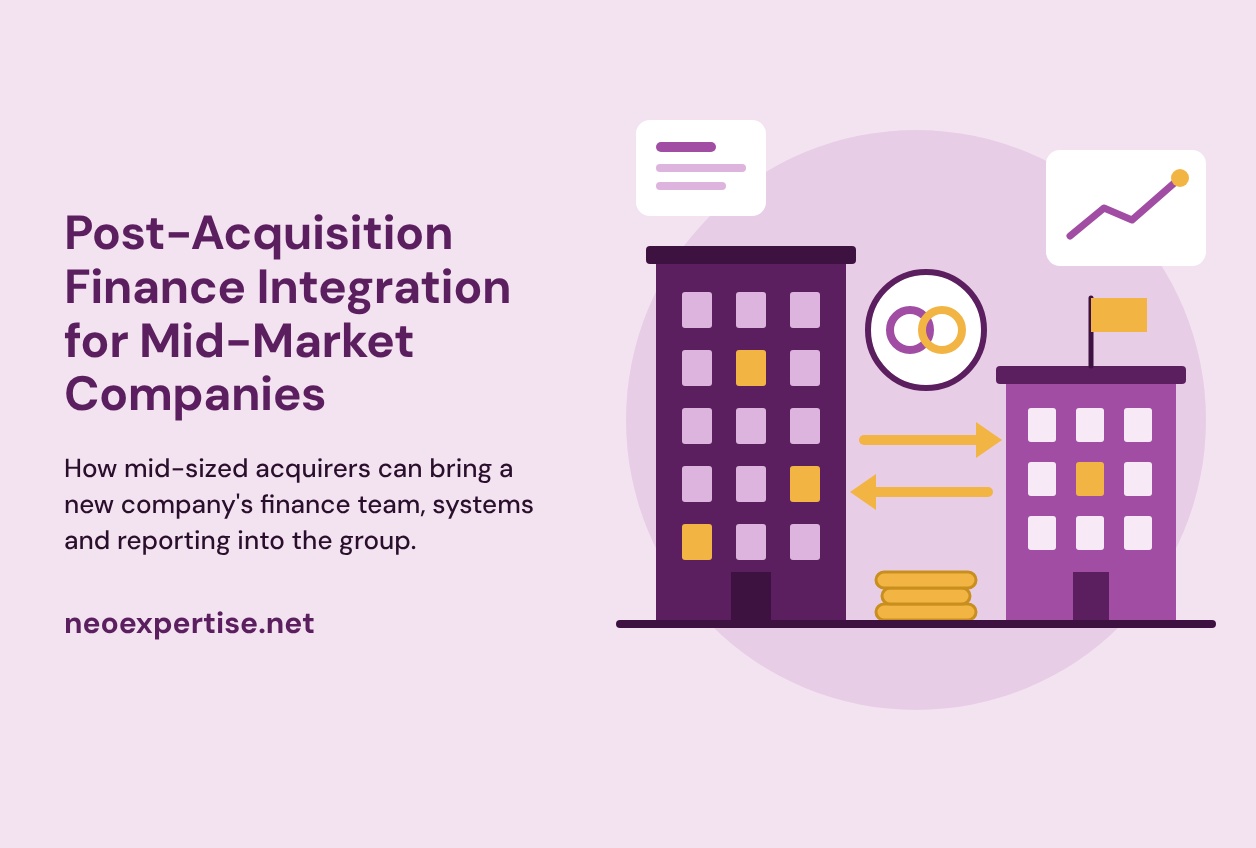
Finance integration for mid-market companies looks different from the version described in large-group playbooks. A mid-market acquirer rarely has a dedicated integration office, a standing team of controllers to redeploy, or a consolidation system built for new entities. It has a Finance Director who is also the person reconciling the acquired company’s receivables, a close calendar that was already tight, and a board expecting the first combined numbers on time. This article sets out what post-acquisition finance integration actually requires at that scale: the constraints that define the work, a lean sequence that fits a small team, an illustrative example, and the point at which adding outside capacity is cheaper than letting the close slip.
Key takeaways
- Mid-market finance integration is constrained by people, not by method: the same small team runs the close and the integration.
- Sequence beats coverage. Fix the few balances that drive the group numbers first, and defer the rest.
- The common failure is the Finance Director becoming the single bottleneck, so the monthly close slips while the integration runs.
- A EUR 60m group acquiring an EUR 8m business does not need a large-company integration office, it needs a short priority list and protected capacity.
- Outside capacity is worth it when the alternative is a missed statutory or group reporting deadline, not as a default.
In this article
What makes mid-market finance integration different
Mid-market here means a group above the EU threshold for a small and medium-sized enterprise but below large-corporate scale. The European Commission sets the SME ceiling at fewer than 250 staff and turnover not exceeding EUR 50 million, so a mid-market acquirer typically sits just above that line, with revenue in the tens to low hundreds of millions and a finance team measured in single figures.
At that scale the method of finance integration is the same as at any group: substantiate the opening balance sheet, map the chart of accounts, reconcile intercompany, and bring the subsidiary onto the group close. What changes is the resource behind it. A large group assigns the work to people whose only job is integration. A mid-market group assigns it to people who already have a full job, which is why the binding constraint is capacity and sequence, not technical difficulty. The underlying sequence is the same one set out in the first 100 days finance integration roadmap; the difference is how much of it one small team can carry at once.
The constraints a mid-market acquirer faces
Four constraints shape almost every mid-market integration. Name them at the start, because they decide what is realistic.
No integration office
No PMO, no dedicated team
The work is added to the existing finance function, not handed to a separate one.
Close runs in parallel
The monthly close does not pause
The same people who close the books do the integration, so one competes with the other.
Lean systems
Often no consolidation tool
Many mid-market groups consolidate in a spreadsheet, which strains when a new entity is added.
First or infrequent acquirer
No tested playbook
There is no standard checklist from the last deal, so each step is designed from scratch.
Thin bench
Key-person dependency
One or two people hold the knowledge, so illness or a resignation stalls the whole effort.
The failure mode these produce is predictable. The Finance Director takes on the integration personally, the monthly close starts to slip because the same person cannot do both, and within two cycles the board is getting late numbers for the whole group, not just the new entity. Protecting the recurring close is therefore the first design rule, not an afterthought.
A lean finance integration approach
The lean approach is not a smaller version of the large-group programme. It is a different order of operations built around a small team.
Step 1. Protect the existing close before adding anything. Decide who is ring-fenced to keep the group close on its current timetable, and who is freed for integration. If that split is not possible with current headcount, that is the signal to add temporary capacity, discussed below.
Step 2. Request the real source data, not the pack. Ask for the trial balance at close date from the acquired company’s accounting system, plus the AR, AP and inventory sub-ledgers. The monthly reporting pack is often rebuilt by hand and reconciles only to itself, so it is not a basis for substantiation. This mirrors the discipline in what a CFO should review after an acquisition.
Step 3. Fix the five balances that drive the group numbers first. In most cases these are receivables, payables, inventory, cash, and intercompany. Substantiate those, and defer the long tail of small accounts to a later cycle. Coverage can wait; the balances that move the consolidated result cannot.
Step 4. Map the chart of accounts to the group chart early. Flag any local account that holds more than one type of item, because those are where the mapping stalls and where the first consolidation will break.
Step 5. Bring the subsidiary onto the group close in stages. A manual, reviewed submission for the first cycle is better than a failed attempt at full automation. Full alignment with the group’s subsidiary group reporting preparation can follow once the basics hold.
Once a group makes a second and third acquisition, this sequence becomes a reusable routine, which is the point at which it starts to resemble a finance integration playbook for serial acquirers.
Illustrative example: a EUR 60m group’s first bolt-on
The figures below are illustrative, not a real engagement, and are rounded for clarity. They show how the lean sequence plays out for a EUR 60m revenue group making its first acquisition, an EUR 8m business, with a finance team of four.
| Area | What the lean approach did | Result |
|---|---|---|
| Close protection | Two of four staff ring-fenced on the group close; two on integration for 10 weeks | Group close held at working day 10 throughout |
| Priority balances | Receivables, payables, inventory, cash, intercompany substantiated first | 95% of balance sheet value reviewed in 4 weeks |
| Suspense clear-up | A EUR 95,000 suspense balance investigated and cleared with a board-approved write-off | Opening balance sheet signed off |
| First group close | Manual reviewed submission, not full automation | Delivered on the group timetable, one cycle later than target |
The group did not build an integration office for an EUR 8m deal. It protected the close, worked a short priority list, and accepted a manual first submission. That is the mid-market pattern.
What to keep in-house, and when to add capacity
Most mid-market integration can be done in-house. The question is whether doing it in-house puts the recurring close or a statutory filing at risk. Use the split below.
Keep in-house
- Decisions on materiality, write-offs and provisions
- Relationships with the acquired team
- Chart of accounts mapping and group policy calls
- Final review and sign-off of the numbers
Consider external capacity
- Rebuilding sub-ledger detail from scratch
- Large one-off reconciliation backlogs
- Running the integration while the core team protects the close
- A deadline that will otherwise be missed
The boundary condition is worth stating plainly: external support is not a default for a small deal, and for a straightforward EUR 8m bolt-on it is often unnecessary. It earns its cost when the alternative is a missed deadline. That deadline can be internal, such as a board reporting date, or statutory, such as the consolidated accounts a parent must prepare under the EU Accounting Directive on the annual and consolidated financial statements of undertakings. When a filing is genuinely at risk, temporary capacity is cheaper than a late or restated set of accounts. This is the same logic PE-backed groups apply when they decide when to use external finance integration support.
Planning a first acquisition and unsure how much finance capacity it will take? Discuss your finance integration project with our team.
FAQ
What counts as a mid-market company for finance integration?
A mid-market company sits above the EU SME ceiling of fewer than 250 staff and EUR 50 million turnover, but below large-corporate scale. In finance integration terms, the defining feature is a small finance team with no dedicated integration office, so the work is added to people who already run the monthly close.
How is mid-market finance integration different from a large group’s?
The method is identical, but the resource is not. A large group gives the work to a dedicated team, while a mid-market group gives it to the same people who close the books. That makes capacity and sequence the binding constraint, rather than technical difficulty.
What should a mid-market finance team prioritise after an acquisition?
Protect the existing group close first, then substantiate the five balances that drive the consolidated result: receivables, payables, inventory, cash, and intercompany. Defer the long tail of small accounts. Fixing the few balances that move the numbers matters more than full coverage in the first cycle.
When should a mid-market company bring in outside finance support?
When doing the integration in-house would put the recurring close or a statutory filing at risk. For a small, straightforward bolt-on it is often unnecessary. It earns its cost when a deadline would otherwise be missed, because a late or restated set of accounts is more expensive.

Brahim Rami | Member of institute of chartered accountants in Morocco
He is a CPA and tax advisor, founder of NeoExpertise.net, a Legal and Tax firm helping foreign companies with business setup, due diligence, payroll, and tax compliance in Morocco and Africa.