
A case: a portfolio company hits a critical moment, and its finance team cannot absorb it alone
THE SHORT VERSION
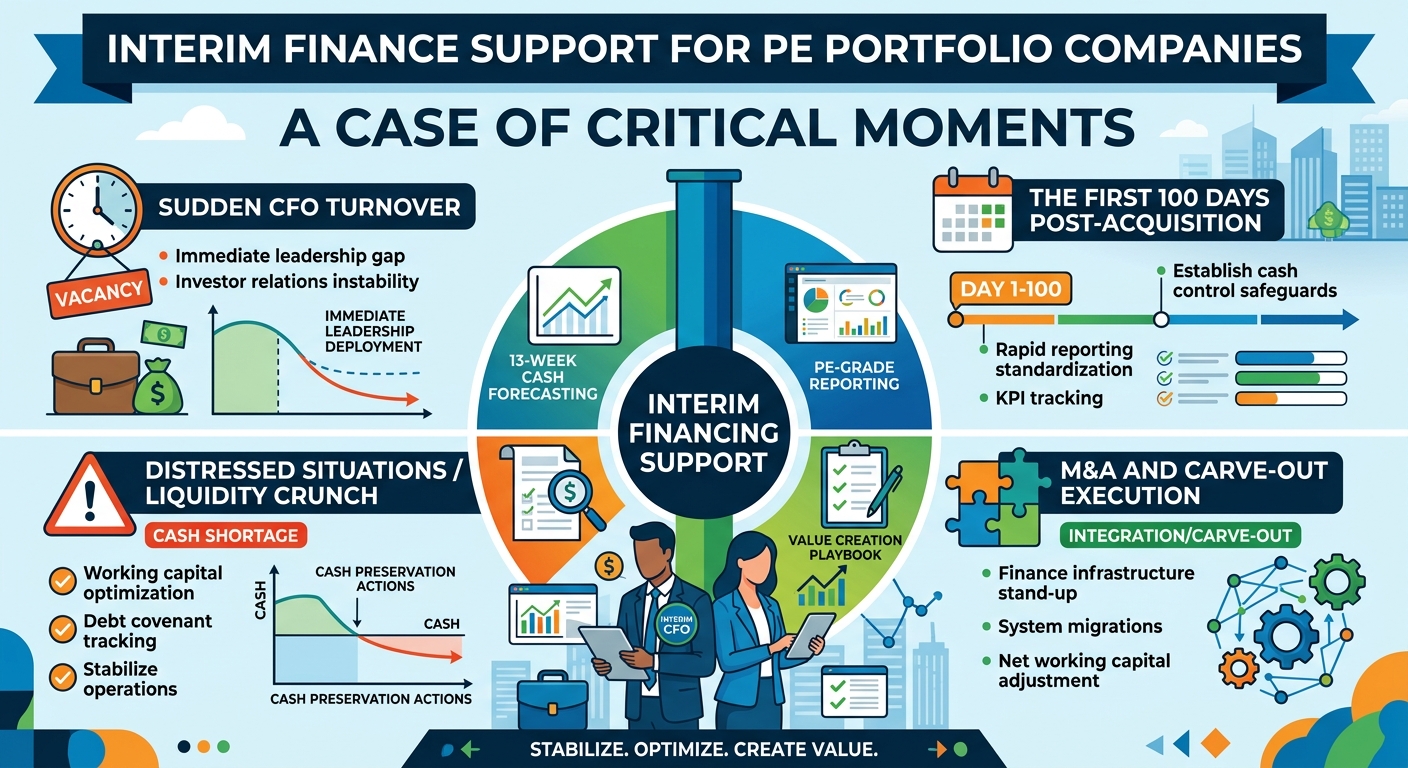
A private equity firm sees the same pattern across its portfolio: a company reaches a critical moment (an acquisition, a system change, a key departure, rapid growth) and the finance team lacks the capacity or the specific expertise to handle it.
Hiring permanently takes months. The problem needs solving in weeks.
The answer is interim finance support: experienced specialists who join quickly, protect the close and the accuracy of the numbers, stabilise the situation, transfer their knowledge and hand responsibility back to the permanent team.
Interim finance support for portfolio companies is one of the most practical levers a private equity operating team has, and one of the easiest to use badly. This case follows a situation portfolio operations teams see repeatedly: a portfolio company facing a critical finance moment without the internal capacity to handle it. It sets out how the problem was identified, how the gaps were assessed, how experienced finance specialists were deployed, how the business was kept running, and how responsibility returned to the permanent team. The case is representative, not a named fund or company, and it is the type of situation NEO Expertise supports finance teams through.
On this page
- The situation
- Step 1: Identify the critical problem and the gap
- Step 2: Deploy experienced finance specialists
- Step 3: Protect the close and the numbers
- Step 4: Stabilise and keep momentum
- Step 5: Transfer knowledge and hand back
- Where interim support goes wrong
- Interim Finance Support Checklist
- Frequently asked questions
The Situation
A private equity firm holds several mid-market portfolio companies. Each has a lean finance team sized for steady-state operations. Over one quarter, three of them hit a critical moment at the same time: one has completed a bolt-on acquisition, one is replacing its ERP system, and one has lost its Financial Controller with two weeks’ notice.
The operating partner’s concern is the same in all three: monthly reporting to the fund must stay on time and accurate, lender covenant reporting cannot slip, and the value creation plan cannot stall while the finance team fights fires. In one company, the gaps also extend to HR systems, which sits outside finance and needs its own specialist.
The simple version of the case: a portfolio company has a problem or a gap in expertise, needs an expert quickly, brings one in temporarily, solves the gap and keeps the business running.
Step 1: Identify the Critical Problem and the Gap
The first step was separating symptoms from causes in each company. A late monthly pack is a symptom. The cause might be a capacity gap (not enough hours), a capability gap (nobody knows how to do the work), or a single point of failure (only one person can).
The operating team assessed each company’s internal capacity, identified the urgent resource needs, and named the risks if nothing changed.
Illustrative portfolio triage:
| Company | Critical moment | Finance gap | Risk if nothing changes | Support needed |
|---|---|---|---|---|
| A | Bolt-on acquisition | Capacity: team closing two ledgers | Close moves from day 7 to day 15 | 1 senior accountant, 4 months |
| B | ERP replacement | Capability: no consolidation testing experience | Go-live with untested consolidation | 1 systems accountant, 6 months |
| C | Controller resignation | Single point of failure | Covenant certificate due in 5 weeks | Interim Controller, until hire starts |
The triage made the priorities obvious. Company C had the shortest deadline and the highest consequence, so it came first.
Step 2: Deploy Experienced Finance Specialists
Speed mattered more than anything else. The specialists deployed were experienced enough to be productive in the first week, without a long onboarding: people who had run a close, prepared covenant reporting, or tested a consolidation before.
Each deployment started with a written scope of one page: the problem, the deliverables, the permanent team member each specialist would work alongside, and the conditions for stepping back. The exit condition was agreed on day one, not when the budget ran out.
The specialists joined the existing finance teams and worked under the local CFO or finance lead, not as a separate project reporting to the fund. That kept the portfolio company’s management in charge, and it meant the permanent team saw how the work was done, not just the result.
The first week followed the same pattern in each company. Day one: system access, the close calendar, the last three months’ reporting packs and the list of open reconciliations. Days two and three: a walk through the previous close with the person who ran it, noting every step that depended on memory rather than a written procedure. By the end of the week, each specialist had a list of what was at risk in the next close, which went to the local finance lead and the operating partner in the same message. That list, not the scope document, became the working plan.
Step 3: Protect the Close and the Numbers
In every company, the non-negotiable was the same: month-end close timelines and financial accuracy. The fund’s reporting, lender covenants and the statutory calendar all depend on them. In the UK, for example, a private company’s annual accounts must be filed within nine months of the year end under section 442 of the Companies Act 2006, and funds managed under the EU’s Alternative Investment Fund Managers Directive have their own reporting obligations when they control non-listed companies. None of those deadlines move because a Controller has resigned.
At company C, the interim Controller’s first action was a list of every recurring deliverable over the next 90 days, with its deadline and owner. Two items had no owner: the covenant certificate and a VAT return. Both were delivered on time.
At company A, the senior accountant took over the acquired company’s ledger so the existing team could keep closing the original business on its usual timetable, following the sequence in the first 100 days finance integration roadmap.
Step 4: Stabilise and Keep Momentum
Stabilising meant bringing each situation back to routine: the close back on its timetable, reconciliations current, and the transformation or integration work moving again. The operating team tracked each deployment weekly against its scope, with issues escalated quickly rather than discovered at the next board meeting.
Across the portfolio, the benefit was momentum. The value creation plans did not stall for a quarter because three finance teams were absorbed by one-off problems. For groups doing repeated acquisitions, the same interim model fits naturally into a finance integration playbook for serial acquirers.
Step 5: Transfer Knowledge and Hand Back
Every deployment ended the same way. The specialists documented the processes they had run, trained the permanent staff to run them, and transferred responsibilities back one by one. Temporary capability gaps were closed, and the processes left behind were built to be sustainable as each company grew.
At company C, the handover ran for two weeks after the new Controller started, with the interim and permanent Controllers running one close together. At company B, the systems accountant stayed through the first two closes on the new ERP and then stepped back.
Where Interim Support Goes Wrong
- No exit condition. Without a defined end point, interim support becomes a permanent cost that nobody decided to incur.
- A parallel team. Specialists working separately from the permanent staff leave nothing behind when they go.
- Too junior, too late. Interim support is for critical moments. It needs people who are productive in week one, deployed before the deadline is missed, not after.
- Treating a capability gap as a capacity gap. Adding hours does not help if nobody on the team knows how to do the work.
Interim support is the wrong answer when the gap is permanent. If a portfolio company will need a second senior accountant for the foreseeable future, hire one. Use interim support to bridge the hiring period, not to replace the hire.
The Interim Finance Support Checklist
Use this as a working checklist. Each item is a check to complete, not a topic to consider.
Diagnose
- ☐ Separate capacity gaps, capability gaps and single points of failure
- ☐ List the deadlines at risk: close, covenants, tax and statutory filings
- ☐ Rank companies by consequence and by how soon the deadline falls
Deploy
- ☐ Write a one-page scope: problem, deliverables, counterpart, exit condition
- ☐ Arrange system access for day one
- ☐ Name the permanent team member each specialist works alongside
- ☐ Have specialists report to the local finance lead, not to the fund
Protect the basics
- ☐ List every recurring deliverable for the next 90 days with an owner
- ☐ Protect close timelines and financial accuracy above project work
- ☐ Review each deployment weekly against its scope and escalate early
Hand back
- ☐ Document processes as they are run
- ☐ Train permanent staff throughout, not at the end
- ☐ Transfer responsibilities one task at a time
- ☐ Run at least one close together before stepping back
Frequently Asked Questions
When should a PE portfolio company use interim finance support?
At critical moments the permanent team cannot absorb: an acquisition, a system change, a key departure, or rapid growth. The test is whether the gap is temporary and urgent. If it is permanent, hire. If it will cause a missed close, covenant or statutory deadline within weeks, bring in interim support.
How quickly can interim finance specialists become productive?
Experienced specialists who have run a close, covenant reporting or consolidation before are usually productive within the first week, provided they have a one-page scope, system access on day one, and a named permanent team member to work alongside from the start.
How do you hand responsibility back from interim support?
Agree the exit condition at the start, document processes as the work is done, train the permanent staff throughout, and transfer tasks one at a time. Where possible, run at least one close with the interim and permanent person working together before the interim support steps back.
NEXT STEP
NEO Expertise supports private-equity-backed finance teams at critical moments, adding experienced capacity for the close, reconciliations and integration work, and handing it back to your team once the situation is stable. You can discuss your finance integration project with our team.

Brahim Rami | Member of institute of chartered accountants in Morocco
He is a CPA and tax advisor, founder of NeoExpertise.net, a Legal and Tax firm helping foreign companies with business setup, due diligence, payroll, and tax compliance in Morocco and Africa.