
A carve-out case: separating a business that never had its own finance function
THE SHORT VERSION
A group decides to separate one of its business units. The unit has traded for years, but its accounting has always lived inside the group’s shared ledgers, shared finance team and shared bank accounts.
Before the separation can complete, finance has to build an independent finance and accounting structure, prepare and reconcile carve-out financial statements, account for the transaction itself, and stand up standalone reporting, all while the existing team keeps running the normal close.
After separation, the work continues: goodwill, impairment, tax steps, and the projects that were postponed to make room for the deal.
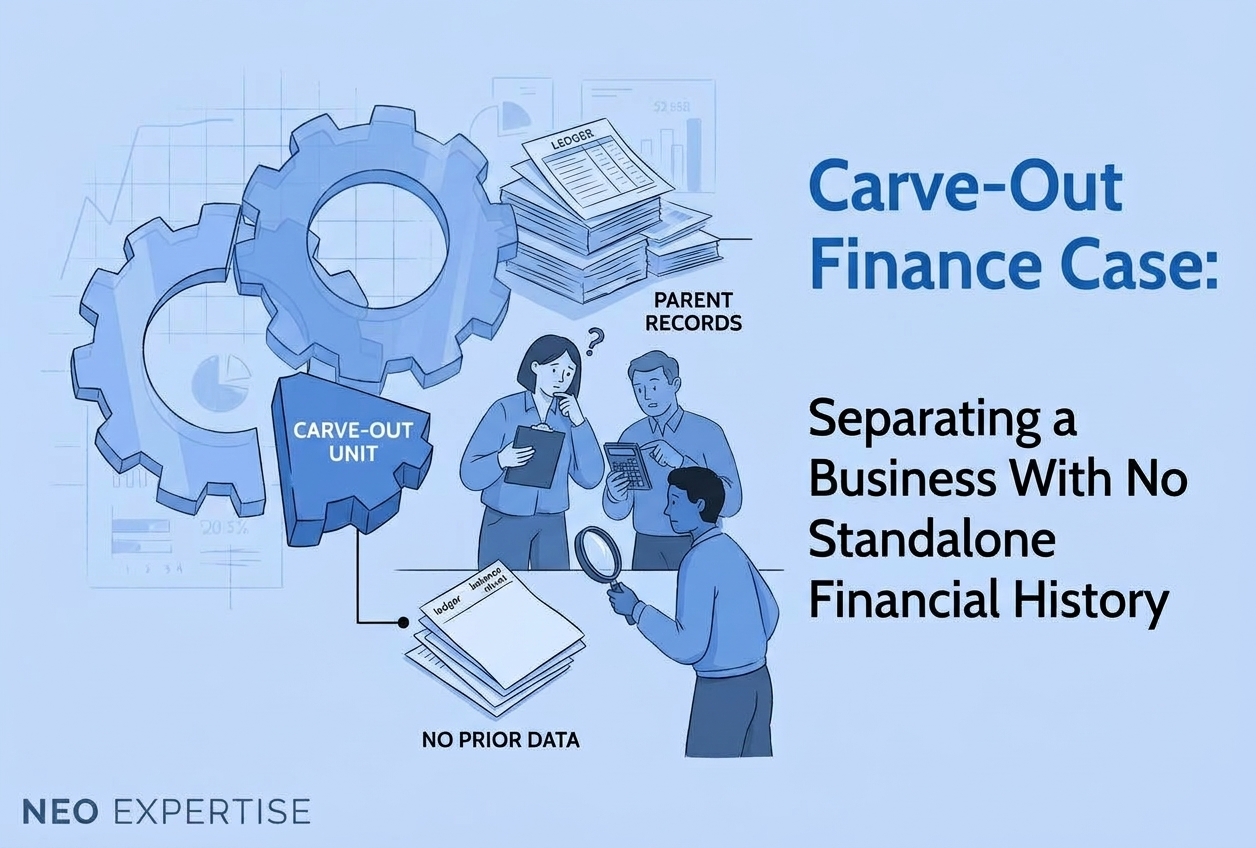
Carve-out standalone financial statements are usually the first thing a separation needs and the last thing that already exists. This case follows a situation finance teams meet regularly: a large group separating a business unit that has never reported on its own. It sets out the problems finance faced, the order in which the work was done, the transaction accounting, the capacity pressure on the team, and what remained after the separation. The case is representative of how these separations unfold, not a description of a named company. It is the type of situation NEO Expertise supports finance teams through.
On this page
The Situation
A large multinational group agrees to separate one of its business units. The unit trades through several legal entities that it shares with the group’s retained businesses. Its results appear in the group accounts as a segment, but it has never produced a balance sheet, a cost base or a set of financial statements of its own.
The deal timetable is fixed. The finance team responsible for the separation is the same team that runs the group’s monthly close, quarterly reporting and audit. Nobody is released from business as usual to work on the carve-out.
A carve-out has no standalone financial history when its results were only ever reported as part of a larger group, with no complete ledger, balance sheet or cost base of its own. That was the starting point here.
What Made It Difficult
- No independent finance structure. Accounting, payables, receivables, payroll and treasury for the unit were all performed by the group’s shared teams.
- Mixed data. The unit’s transactions sat in the same ledgers as the retained businesses, so every balance had to be separated before it could be reported.
- Transaction accounting on top. The group had to account for the separation in its own books: classification, gain or loss, equity effects and intercompany investments.
- A team at capacity. Several finance roles depended on people who would stay with the former parent, and the separation ran through holiday periods and staff absences.
How the Finance Work Was Sequenced
1. Define the perimeter
The first task was agreeing exactly what was being separated. Finance listed the legal entities in the transaction, confirmed which assets and liabilities belonged to each, and reviewed the entity transfers and ownership changes planned in the deal documents. Every balance sheet line was assigned to one entity before any numbers were prepared. Where an entity was shared with the retained business, the split was agreed line by line, not by percentage.
2. Separate the data and prepare the carve-out financial statements
The unit’s transactions were extracted from the shared source ledgers at transaction level, not taken from the management reporting pack, which had been rebuilt in spreadsheets and did not tie back to the ledger. Shared costs such as IT, finance and HR, previously charged to the unit as allocations, were documented with their allocation basis so the statements could disclose how they were derived.
3. Reconcile the carve-out financial statements
The carve-out statements were then reconciled in both directions: down to the transaction-level extract, and up to the group’s consolidated figures, so that the unit plus the retained business equalled the group. Differences were investigated and cleared one by one. An unreconciled carve-out balance sheet is the version the other side’s advisers will find first.
4. Account for the transaction
In parallel, finance worked through the accounting for the separation itself. For groups applying IFRS as endorsed in the EU under Regulation (EC) No 1126/2008, that typically covers:
- Reviewing whether the unit’s assets met the criteria to be classified as held for sale under IFRS 5, and remeasuring them if so.
- Identifying the assets and liabilities transferred with the business, and reviewing the effect on equity accounts, including reserves that have to be reclassified on disposal.
- Reviewing intercompany balances and investments between the unit and the rest of the group, which stop eliminating once the unit leaves.
- Calculating the gain or loss on the transaction, including the share of goodwill allocated to the disposed operation.
- Where the group reports under US GAAP, deciding whether to apply push-down accounting in the separated entity’s own books, a policy election to settle with the auditors before the opening balance sheet is posted.
5. Stand up independent reporting and controls
Finance established reporting processes for the standalone company, defined which responsibilities sat with the new company and which with the former parent during the transition, created standard finance processes and documentation, and set controls over financial reporting. The step ended with the first reporting cycle after separation, which is the real test of whether the structure works.
6. Protect capacity and business as usual
The team assessed its capacity against the separation plan, identified the roles that depended on the former parent, and brought in temporary finance support where the gaps were largest. The aim was simple: keep the group’s own close, reporting and audit on schedule while the carve-out work ran alongside, including through absences and handover periods.
7. Finish the work after separation
Completion did not end the project. Finance still had to analyse the remaining goodwill, perform impairment assessments on the cash-generating units affected by the reorganisation, execute the relevant tax steps, and pick up the finance projects that had been postponed to make room for the deal. The last step was turning what had been learned into repeatable processes and a playbook, so the next transaction starts from a model rather than a blank page.
The Transaction Accounting in Numbers
Illustrative figures. They show the mechanics, not a real transaction.
The unit is sold for €120.0 million. It sits inside a cash-generating unit carrying €61.7 million of goodwill. On a relative value basis, the disposed operation represents 30% of that unit’s value, so €18.5 million of goodwill leaves with it, as IAS 36 requires when an operation is disposed of from a unit to which goodwill was allocated.
| Component | € million |
|---|---|
| Sale proceeds | 120.0 |
| Carrying amount of net assets disposed | (78.0) |
| Goodwill allocated to the disposed operation (30% of 61.7) | (18.5) |
| Cumulative translation reserve reclassified to profit or loss | 2.1 |
| Transaction costs | (3.2) |
| Gain on disposal | 22.4 |
Two lines in that table are regularly missed at the first attempt: the goodwill allocation, because goodwill is usually tracked at a level above the unit, and the translation reserve, because it sits in equity and not in the unit’s balance sheet. The remaining €43.2 million of goodwill then needs an impairment review, since the unit it belongs to has changed shape.
Where Carve-Outs Usually Go Wrong
- Carve-out statements that do not reconcile to the group. If the unit plus the retained business does not equal the consolidated figures, the difference is usually an allocation applied twice or an intercompany balance eliminated on only one side.
- Goodwill left in the wrong place. Without the allocation step, the gain on disposal is overstated and the goodwill that remains is too high, which surfaces later as an impairment.
- The first standalone close run without rehearsal. Responsibilities agreed on paper between new company and former parent fail on the first live deadline. A trial close on prior-period data exposes the gaps cheaply.
- Business as usual quietly slipping. When the same people run the close and the separation, the close is what gives way, usually one reconciliation at a time.
When This Approach Does Not Apply
This sequence assumes the separated business trades through identifiable legal entities and can be extracted at transaction level. If it is an asset deal with no legal entity, or the unit shared customers, stock and cost centres so thoroughly that it was never tracked separately, there is no history to extract. In that case, do not reconstruct past periods. Agree an opening balance sheet at the separation date, supported by counts, confirmations and statements, and build the history forward from there. Under UK law, for example, a newly formed company must keep adequate accounting records from the start under section 386 of the Companies Act 2006.
For the buyer’s side of a carve-out, the next stage is integrating the separated business into a new group, covered in preparing a newly acquired subsidiary for group reporting and the first 100 days finance integration roadmap.
The Carve-Out Finance Checklist
Use this as a working checklist. Each item is a check to complete, not a topic to consider.
Perimeter and data
- ☐ List the legal entities included in the transaction
- ☐ Assign every asset and liability to one entity
- ☐ Agree the transaction-level extract rule with the seller in writing
- ☐ Document the basis of every shared cost allocation
Statements and transaction accounting
- ☐ Prepare the carve-out financial statements
- ☐ Reconcile them down to the extract and up to the group consolidated figures
- ☐ Review held-for-sale classification and any remeasurement
- ☐ Identify the assets and liabilities transferred with the business
- ☐ Review equity accounts and reserves to be reclassified on disposal
- ☐ Review intercompany balances and investments with the rest of the group
- ☐ Calculate the gain or loss, including goodwill allocated to the disposed operation
- ☐ Settle any push-down accounting question with the auditors before posting
Standalone operations
- ☐ Establish reporting processes for the standalone company
- ☐ Split responsibilities between the new company and the former parent
- ☐ Document standard finance processes and controls
- ☐ Prepare and run the first reporting cycle after separation
People and after separation
- ☐ Assess finance team capacity against the separation plan
- ☐ Identify roles that depended on the former parent
- ☐ Put temporary finance support in place where the gaps are largest
- ☐ Analyse remaining goodwill and perform impairment assessments
- ☐ Execute the relevant tax steps
- ☐ Restart the finance projects postponed for the deal
- ☐ Write the playbook for the next transaction
Frequently Asked Questions
What are carve-out standalone financial statements?
They are financial statements for a business that was previously part of a larger group, prepared as if it had operated on its own. They present the unit’s own assets, liabilities, revenue and costs, with any shared costs allocated on a documented basis, and they must reconcile back to the group’s consolidated figures.
What accounting does the selling group need for a carve-out?
Typically a review of held-for-sale classification, identification of the assets and liabilities transferred, the gain or loss calculation including allocated goodwill, reclassification of related reserves, and a review of intercompany balances and investments. After completion, the remaining goodwill needs an impairment assessment.
Why does a carve-out need temporary finance support?
Because the separation lands on the same team that runs the monthly close and audit, and some roles depend on people who stay with the former parent. Temporary support covers the peak workload, protects business as usual, and hands the processes to the permanent team once they run.
NEXT STEP
NEO Expertise supports finance teams through carve-outs like this one, adding capacity for the carve-out statements, reconciliations, transaction accounting support and first standalone closes while your team keeps business as usual running. You can discuss your finance integration project with our team.

Brahim Rami | Member of institute of chartered accountants in Morocco
He is a CPA and tax advisor, founder of NeoExpertise.net, a Legal and Tax firm helping foreign companies with business setup, due diligence, payroll, and tax compliance in Morocco and Africa.