Part of our complete guide: How to Start a Business in Morocco (2026 Guide for Foreign Investors)
Morocco operates several free zones and special economic zones that offer significant tax advantages to foreign companies. The right zone depends entirely on your sector. A financial services firm and a manufacturing company have different options, different eligibility conditions, and different tax outcomes.
This guide covers Morocco’s main free zones for foreign investors, what each one offers, who qualifies, and what the setup process looks like in practice.
Not sure which zone fits your business? and get a clear recommendation within 24 hours.
Overview: Morocco’s Main Free Zones and Special Regimes
| Zone | Location | Target Sector | IS Rate | Customs Exemption |
|---|---|---|---|---|
| Casablanca Finance City (CFC) | Casablanca | Finance, professional services, HQ | 15% flat | Partial |
| Tanger Free Zone (TFZ) | Tangier | Manufacturing, logistics, export | 0% for 5 years, then 15% | Yes |
| Tanger Med Industrial Platform | Tangier | Automotive, logistics, industry | 0% for 5 years, then 15% | Yes |
| Atlantic Free Zone (Kenitra) | Kenitra | Automotive, aerospace | 0% for 5 years, then 15% | Yes |
| Midparc | Casablanca | Aeronautics, aerospace | 0% for 5 years, then 15% | Yes |
| Dakhla Atlantic Free Zone | Dakhla | Fishing, agri-processing, logistics | 0% for 5 years, then 15% | Yes |
| Parc Industriel Ain Johra | Ain Johra | Industry, manufacturing | 0% for 5 years, then 15% | Yes |
Casablanca Finance City (CFC): Morocco’s Financial Hub
Casablanca Finance City is Morocco’s flagship special economic zone for financial and professional services companies. Created under Law 44-10, it functions as a regulated business district located in the Casablanca CBD, adjacent to Mohammed V International Airport.
CFC is regularly ranked among Africa’s top financial centers and positions itself as the gateway for companies accessing sub-Saharan African markets from a stable, well-regulated base.
Who Can Establish in CFC in Morocco
CFC status is available to companies in the following categories:
- Financial institutions: banks, insurance companies, asset managers, investment funds
- Holding companies with regional operations across Africa or the MENA region
- Regional and international headquarters of multinational corporations
- Professional services firms: consulting, audit, legal, technology
- Fintech and financial infrastructure companies
CFC status is not available to retail or manufacturing businesses. The zone is strictly for service-oriented and financial operations.
Tax Benefits of CFC Status in Morocco
| Tax Item | CFC Rate | Standard Morocco Rate |
|---|---|---|
| IS (Corporate Tax) | 15% flat | 20 to 35% progressive |
| Dividend withholding tax | 0% for qualifying distributions | 15% standard |
| Professional tax (Taxe Professionnelle) | Exempt for first 5 years | Variable |
| VAT on services within CFC | 0% | 20% |
The 15 percent flat IS rate at CFC is one of the lowest corporate tax rates in the MENA region and significantly below Morocco’s standard progressive rate, which reaches 35 percent for profits above 5 million MAD following the 2023 Finance Law reform.
CFC Substance Requirements in Morocco
CFC status requires genuine substance in Morocco. The CFC Authority evaluates applications based on:
- A physical office within the CFC perimeter in Casablanca
- A minimum number of employees based in Morocco (typically 2 or more full-time staff)
- A defined scope of regional or international activity
- Annual reporting to the CFC Authority
Shell companies or purely administrative presences do not qualify for CFC status. The Authority conducts periodic reviews to confirm ongoing substance.
How to Obtain CFC Status in Morocco
- Submit a formal application to the CFC Authority including your business plan, ownership structure, and projected activity
- Attend an evaluation committee meeting with the CFC Authority
- Receive conditional CFC accreditation (typically within 4 to 8 weeks of a complete application)
- Incorporate a Moroccan SARL or SA and register it with the CRI
- Sign a lease within the CFC perimeter
- Begin operations and file your first annual activity report
CFC status and company incorporation run in parallel. Most companies complete both within 10 to 14 weeks from first application.
Industrial Free Zones: Tax-Free Manufacturing and Export
Morocco’s industrial free zones are designed for companies that manufacture, process, assemble, or export goods. They operate under the Export Free Zone (Zone Franche d’Exportation) legal framework established by Law 19-94, updated through subsequent Finance Laws.
How Industrial Free Zones Work in Morocco
Companies operating in a Moroccan industrial free zone benefit from:
- IS exemption: 0 percent corporate tax for the first 5 years of activity
- IS after year 5: 15 percent flat rate (versus standard 20 to 35 percent)
- Customs exemption: No import duties on equipment, machinery, raw materials, and components used in production
- VAT exemption: On goods and services purchased for use within the zone
- Dividend withholding tax: 0 percent on profits generated from export activities
- No foreign exchange restrictions: Companies can hold and operate accounts in foreign currencies
To qualify, at least 85 percent of production must be exported outside Morocco. Companies selling primarily to the domestic Moroccan market do not qualify for free zone treatment.
Main Industrial Free Zones by Location
Tanger Free Zone (TFZ)
Morocco’s first and largest export free zone, located 10 kilometers from the Tangier Med port. Tanger Free Zone hosts more than 900 companies across automotive, textile, electronics, and logistics sectors. The zone is managed by Tanger Med Zones and offers plug-and-play factory units, warehouses, and land for bespoke construction. Automotive suppliers to Renault and Stellantis (Peugeot-Citroën) operate extensively here.
Tanger Med Industrial Platform (TMIP)
Adjacent to Tangier Med port, Africa’s largest container port by capacity. TMIP focuses on logistics, port-adjacent manufacturing, and export processing. Companies with heavy import-export flows benefit from direct port access with no inland transport cost between the port and the production facility.
Atlantic Free Zone (Kenitra)
Located near Kenitra, 40 kilometers north of Rabat. The Atlantic Free Zone specializes in automotive and aerospace suppliers. PSA Group (Stellantis) operates a major production plant in Kenitra, making this zone attractive for tier-1 and tier-2 automotive suppliers targeting the same customer base.
Midparc (Casablanca)
A specialized aeronautics and aerospace free zone adjacent to Mohammed V International Airport in Casablanca. Midparc hosts suppliers to Airbus, Boeing, Safran, and other international aerospace primes. It operates under the same free zone tax framework with specific aerospace industry support from GIMAS (the Moroccan aerospace industry group).
Dakhla Atlantic Free Zone
Morocco’s newest major free zone, located in Dakhla in the southern part of the country. It targets fishing industry processing, agricultural product processing, logistics for West African trade, and renewable energy projects. The zone benefits from direct Atlantic Ocean access and proximity to Mauritania and Senegal.
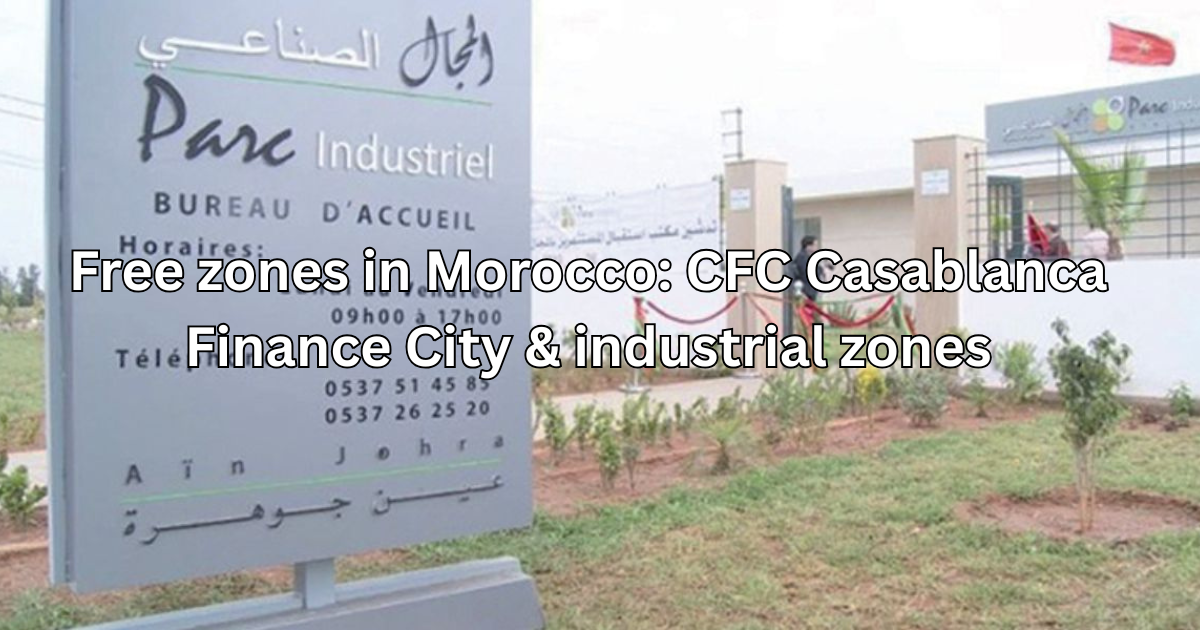
Parc Industriel Ain Johra
A dedicated industrial estate managed under Morocco’s national industrial zone program. Parc Industriel Ain Johra offers serviced plots and facilities for manufacturing and industrial companies.
CFC vs Industrial Free Zone: Which Is Right for Your Business?
| Criteria | CFC | Industrial Free Zone |
|---|---|---|
| Business type | Financial services, professional services, HQ | Manufacturing, processing, export logistics |
| IS rate | 15% flat (permanent) | 0% for 5 years, then 15% |
| Minimum staff | Yes (typically 2+) | No minimum specified |
| Export requirement | Not applicable | 85% of output must be exported |
| Physical office required | Yes, within CFC perimeter | Yes, within the zone |
| Application body | CFC Authority | Zone management authority (e.g., Tanger Med Zones) |
| Setup timeline | 10 to 14 weeks | 8 to 16 weeks |
| Best for | Fund managers, regional HQ, consulting firms | Automotive suppliers, aerospace, textiles, logistics |
How to Set Up a Company in a Morocco Free Zone
The process is similar across zones, with the zone authority replacing the standard CRI role at the accreditation stage:
- Select the appropriate zone based on your sector and export destination
- Contact the zone authority (CFC Authority, Tanger Med Zones, Atlantic Free Zone Authority, or AMDIE for national guidance) to confirm eligibility
- Submit a project application including your business plan, production capacity, employment projections, and investment amount
- Sign a land lease or facility agreement within the zone
- Incorporate your Moroccan SARL or SA at the CRI, referencing your free zone accreditation
- Register with the DGI (tax authority) and CNSS (social security) as in standard incorporation
- Apply for any sector-specific licenses (required for financial services at CFC)
- Begin operations and file annual activity reports to maintain zone status
AMDIE (Agence Marocaine de Développement des Investissements et des Exportations) is Morocco’s national investment promotion agency and the first point of contact for large-scale investment projects. For investments above 100 million MAD, AMDIE coordinates with the Investment Commission and may secure additional incentives under Morocco’s Investment Support Fund (Fonds de Soutien à l’Investissement).
Frequently Asked Questions
What is Casablanca Finance City and who can use it?
Casablanca Finance City (CFC) is a special economic zone in Casablanca for financial services companies, holding companies, multinational regional headquarters, and professional services firms. Companies with CFC status pay a flat 15 percent corporate tax rate instead of Morocco’s standard 20 to 35 percent progressive rate, and qualify for 0 percent withholding tax on qualifying dividend distributions. Retail and manufacturing companies do not qualify.
What is the corporate tax rate in Morocco’s industrial free zones?
Companies operating in Morocco’s industrial free zones pay 0 percent IS (corporate tax) for their first 5 consecutive years of activity, followed by a flat 15 percent rate thereafter. This compares to Morocco’s standard rate of 20 to 35 percent for companies outside free zones. The 15 percent rate applies permanently after the initial exemption period ends.
Do free zone companies in Morocco need a Moroccan partner?
No. Morocco’s Investment Charter of 2022 permits 100 percent foreign ownership in both CFC and industrial free zones. There is no requirement to have a Moroccan shareholder, director, or partner in any of Morocco’s free zones.
What is the 85 percent export rule in Morocco’s industrial free zones?
To maintain industrial free zone status, a company must export at least 85 percent of its production or output outside Morocco. Companies that sell primarily to the domestic Moroccan market do not qualify for free zone status. Occasional domestic sales below the 15 percent threshold are permitted and subject to standard Moroccan import duties and VAT.
Can a company have CFC status and sell to African markets from Morocco?
Yes. CFC is specifically designed for companies that use Morocco as a base to serve African or MENA markets. A consulting firm, fund manager, or regional headquarters company can be incorporated in CFC in Casablanca and generate revenues from clients across Africa, Europe, or the Middle East while benefiting from the 15 percent flat IS rate and 0 percent dividend withholding on qualifying distributions.
How long does it take to set up in a Morocco free zone?
Timeline varies by zone. CFC accreditation and company incorporation together typically take 10 to 14 weeks. Industrial free zone setup takes 8 to 16 weeks depending on whether you lease an existing facility or require construction. Both timelines assume a complete application submitted without missing documents.
Start Your Morocco Free Zone Setup
Setting up in a Moroccan free zone adds one layer of coordination compared to standard company registration. You manage both the zone authority application and the CRI incorporation in parallel. Missing documents or sector eligibility issues are the most common causes of delays.
Neoexpertise works with foreign companies across all major Moroccan free zones and handles both the zone accreditation and the SARL or SA incorporation process end to end.
For a complete overview of all Morocco business setup options, visit our pillar guide: How to Start a Business in Morocco (2026 Guide for Foreign Investors)

Brahim Rami | Member of institute of chartered accountants in Morocco
He is a CPA and tax advisor, founder of NeoExpertise.net, a Legal and Tax firm helping foreign companies with business setup, due diligence, payroll, and tax compliance in Morocco and Africa.