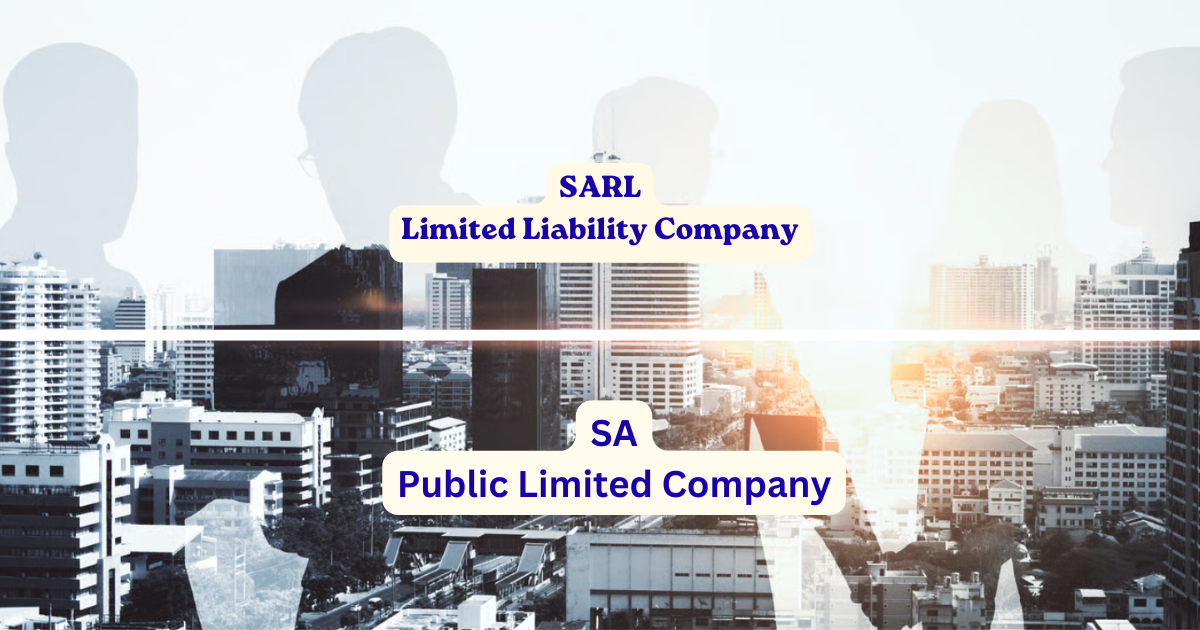
Choosing between a SARL and an SA is the most consequential decision you make when incorporating in Morocco. The SARL SA Morocco difference goes far beyond paperwork: it determines your minimum capital, how many shareholders you need, whether you can ever list on a stock exchange, and how much governance overhead you carry every year.
Most foreign investors default to whichever structure their lawyer suggests without fully understanding what they’re committing to. That shortcut is avoidable.
This guide breaks both structures down side by side — their legal requirements, practical advantages, costs, and the exact business scenarios where each one applies. By the end, you will know which entity fits your situation before you file a single document.
Still deciding whether to incorporate in Morocco at all? Start here first.
SARL vs SA Morocco at a Glance
| Feature | SARL | SA |
|---|---|---|
| Full name | Société à Responsabilité Limitée | Société Anonyme |
| Governing law | Loi 5-96 (amended 2006) | Loi 17-95 (amended 2008) |
| Min. associates / shareholders | 1 (SARL-AU) | 5 |
| Max. associates / shareholders | 50 | No limit |
| Minimum capital social | MAD 100 (no fixed statutory min. since 2006) | MAD 300,000 private / MAD 3,000,000 public |
| Ownership units | Parts sociales | Actions (shares) |
| Share transferability | Requires associate approval | Freely transferable by default |
| Management | Gérant | Conseil d’Administration + PDG |
| Statutory audit | Only above thresholds | Mandatory every year |
| 100% foreign ownership | Allowed | Allowed |
| Stock exchange listing | Not permitted | Permitted |
| Typical formation time | 1 week | 1–2 weeks |
| Best for | SMEs, startups, foreign investors starting out | Large companies, institutional investors, future IPO |
What Is the SARL SA Morocco Difference?
The SARL (Société à Responsabilité Limitée) and the SA (Société Anonyme) are Morocco’s two dominant commercial entities for limited-liability business activity. Both protect your personal assets from company debts. The split is about scale and governance complexity.
SARL is the Moroccan equivalent of a limited liability company (LLC). It’s built for small to medium businesses: low capital floor, minimal governance overhead, fast to set up. The governing text is Loi 5-96, which was amended in 2006 to remove the previous MAD 100,000 minimum capital requirement.
SA is the Moroccan equivalent of a joint-stock company or corporation. It’s designed for larger organizations with multiple institutional shareholders, formal accountability structures, or plans to access public capital markets. The governing text is Loi 17-95 on Sociétés Anonymes.
Everything else capital minimums, management structure, share transfer rules, audit obligations flows from that fundamental difference in purpose.
SARL in Morocco: Requirements and Key Features
Legal Framework in Morocco
The SARL is governed by Loi 5-96, as reformed. The 2006 amendment was significant: it eliminated the MAD 100,000 minimum capital requirement, making the SARL the most accessible corporate vehicle in Morocco for entrepreneurs and foreign investors at any stage.
Associates (Associés)
A SARL requires between 1 and 50 associates (associés). When there is exactly one, the entity is called a SARL-AU (Société à Responsabilité Limitée à Associé Unique) — the single-member version. This is the most common structure chosen by solo founders and foreign companies setting up a Moroccan subsidiary.
If the number of associates exceeds 50, Moroccan law requires conversion to an SA.
Minimum Capital Social
Since the 2006 reform, there is no fixed statutory minimum. The technical floor is MAD 100. In practice, most SARLs register a capital social between MAD 10,000 and MAD 100,000, reflecting the realistic needs of the business — but the law does not impose a number.
The capital is divided into parts sociales. These cannot be freely sold or transferred to a third party outside the company: any such transfer requires approval from the other associates. This rule keeps ownership closed and predictable.
Management: The Gérant
A SARL is managed by one or more gérants (managers). The gérant can be an associate or an external appointee, Moroccan or foreign. There is no board requirement. The gérant handles daily operations and legally represents the company. Decision-making is direct and fast — no board resolutions required for routine matters.
Audit Requirements
A SARL must appoint a commissaire aux comptes (statutory auditor) only if it exceeds two of three thresholds in a given financial year:
- Net assets above MAD 50 million
- Turnover above MAD 50 million
- More than 50 employees
The majority of SME and startup SARLs never trigger this obligation — a meaningful annual cost saving compared to SA.
SARL Best Fits
- Foreign investors entering Morocco for the first time
- Startups and SMEs with 1–50 owners
- Businesses that need operational speed and low governance overhead
- Companies with no plans to raise public capital or list on a stock exchange
- Joint ventures with a stable, known partner group
SA in Morocco: Requirements and Key Features
Legal Framework
The SA is governed by Loi 17-95, which aligns Morocco’s joint-stock company rules with international corporate governance standards. It is a more demanding structure by design, built for accountability to a larger and more diverse shareholder base.
Shareholders (Actionnaires)
An SA requires a minimum of 5 shareholders (actionnaires) at formation. There is no upper limit. Shareholders hold actions (shares), which are freely transferable by default — meaning ownership can change without requiring consent from other shareholders. This is the structural feature that makes SA the right vehicle for investor liquidity and eventual market listing.
Minimum Capital Social
The minimum capital social for an SA is:
- MAD 300,000 for a private SA (no public offering)
- MAD 3,000,000 for an SA making an appel public à l’épargne (public capital offering)
At formation, at least 25% of the subscribed capital must be paid up immediately, with the balance due within 3 years.
The capital is divided into actions with a minimum nominal value. Share certificates are issued and governed formally.
Management: Conseil d’Administration + PDG
An SA runs on a two-layer governance structure:
- Conseil d’Administration (Board of Directors): minimum 3, maximum 12 members, elected by shareholders at the AGM
- PDG (Président-Directeur Général): the chief executive who also chairs the board, legally represents the company
As an alternative, some SAs adopt a Directoire (Executive Board) + Conseil de Surveillance (Supervisory Board) model, though this is less common in Moroccan practice.
This governance structure creates overhead — board meetings, minutes, AGM documentation — but also generates institutional credibility that matters when dealing with banks, government contracts, or international partners.
Audit Requirements
Every SA must appoint a commissaire aux comptes without exception, regardless of size. This mandatory audit is an annual fixed cost. Budget between MAD 15,000 and MAD 50,000 per year depending on company size and auditor tier. This applies from the first full financial year of operation.
SA Best Fits
- Large companies with 5+ institutional co-founders
- Businesses planning to raise private equity or venture capital
- Companies with a path toward Casablanca Stock Exchange (Bourse de Casablanca) listing
- Subsidiaries of multinationals that require formal governance documentation for head-office compliance
- Corporate joint ventures between large entities
SARL vs SA Morocco: The Key Differences in Practice
Capital Barrier
SARL has no meaningful capital barrier — MAD 100 is the floor. SA requires MAD 300,000 paid-in capital at formation, with 25% due immediately. For a bootstrapped business or a first Morocco market entry, this is a real constraint. For a company planning to raise MAD 5 million in year one, the MAD 300,000 minimum is irrelevant.
Governance Load
A SARL gérant can be the sole associate and sole manager simultaneously — one person runs the company legally and operationally with minimal paperwork. An SA needs at least 3 board members, a PDG, AGM minutes, board resolutions, and annual audited accounts filed with the Registre de Commerce. The time cost of SA governance is substantially higher.
Share Transfer Rules
This is one of the most practically consequential differences:
- SARL parts sociales: transfer to an outsider requires approval from associates holding at least three-quarters of the capital social. Unknown new owners cannot enter without consent.
- SA actions: freely transferable by default. Ownership can shift without the company’s involvement.
If you want stable, controlled ownership, SARL’s approval requirement protects you. If you need investor liquidity — the ability to sell shares without asking permission — SA provides that.
Annual Compliance Cost
| Item | SARL (typical SME) | SA (all) |
|---|---|---|
| Statutory audit | Not required | It depends on the company |
| Board documentation | Not required | Required |
| AGM requirement | Required (once/year) | Required (once/year) |
| Annual filings | Standard | Standard + audit report |
Stock Exchange Access
Only an SA can list on the Casablanca Stock Exchange. A SARL that grows to a stage where an IPO is relevant must first convert to an SA — a formal process involving restatement of statuts, meeting capital requirements, and convening a constituent general meeting. Possible, but adds time and cost. If an IPO is part of your plan, start as an SA.
Foreign Ownership
Both structures allow 100% foreign ownership under Moroccan investment law. No Moroccan co-owner is required in most commercial sectors. Foreign nationals and foreign legal entities can hold 100% of parts sociales or actions. Certain regulated sectors — banking, insurance, some telecommunications activities — carry sector-specific rules, but for the majority of commercial, service, and technology businesses, full foreign ownership is unrestricted in both SARL and SA.
Which Company Structure Is Best for Foreign Investors in Morocco?
The decision depends on three factors: starting capital, expected growth trajectory, and governance preference. Three scenarios cover most situations.
Scenario 1: Solo Founder or Small Team Entering Morocco
Use a SARL-AU or SARL.
You need speed, low capital, and minimal overhead. A SARL lets you open with MAD 100 in capital social, operate with a single gérant, and add up to 49 associates as you scale. Formation typically completes in 1–3 weeks through the CRI. Audit is not required below the thresholds. For first-entry Morocco incorporations, SARL is the standard choice for exactly these reasons.
Scenario 2: Multi-Party Joint Venture
Use SARL if partners ≤50 and governance is informal. Use SA if institutional governance is required.
A SARL protects ownership stability through transfer approval rules — useful when all partners know each other and you want to prevent outside parties from acquiring stakes without consent. If your joint venture involves institutional co-investors, banks, or partners who expect eventual liquidity from share sales, the SA’s free transferability and formal governance structure serve those needs better.
Scenario 3: Large-Scale Investment or Future Capital Raise
Use SA.
If your business plan includes raising external capital — private equity, venture funding, or public markets — structure as an SA from the start. The formal board, freely transferable shares, and mandatory audit become credibility signals, not burdens, when presenting to institutional investors. The MAD 300,000 minimum capital is a rounding error against the capital you plan to raise.
How to Register a SARL or SA in Morocco
Both structures are registered through Morocco’s Centre Régional d’Investissement (CRI), the government one-stop shop for business formation. The core steps are:
- Reserve company name — search and reserve at OMPIC (Office Marocain de la Propriété Industrielle et Commerciale)
- Draft statuts (articles of association) — notarization optional for SARL, mandatory for SA
- Open a blocked bank account and deposit the capital social
- File with the CRI — submit statuts, founding documents, identity documents, and proof of capital deposit
- Register at the Registre de Commerce (commercial registry)
- Obtain tax IDs — ICE (company identifier), taxe professionnelle, patente
- Publish in the Bulletin Officiel
SARL formation: 1 week. SA formation: 1–2 weeks due to additional notarial and governance requirements.
For the complete step-by-step process, document checklist, and current CRI procedures: ttps://neoexpertise.net/how-to-start-a-business-in-morocco/
Frequently Asked Questions
What is the difference between SARL and SA in Morocco?
A SARL (Société à Responsabilité Limitée) is a limited liability company for 1–50 associates with no fixed minimum capital, governed by Loi 5-96. An SA (Société Anonyme) requires at least 5 shareholders, MAD 300,000 minimum capital, and a formal board of directors, governed by Loi 17-95. SARL suits SMEs; SA suits large companies and those planning to raise public capital.
What is the minimum capital for a SARL in Morocco?
Since the 2006 reform to Loi 5-96, there is no fixed statutory minimum capital for a SARL in Morocco. The technical floor is MAD 100. Most SARLs in practice register capital between MAD 10,000 and MAD 100,000, reflecting realistic business needs, but the law imposes no specific amount
What is the minimum capital for an SA in Morocco?
An SA in Morocco requires minimum capital social of MAD 300,000 for a private company with no public offering. If the SA conducts an appel public à l’épargne (public capital offering), the minimum rises to MAD 3,000,000. At formation, at least 25% must be paid up immediately; the balance is due within 3 years.
Can foreigners own 100% of a SARL in Morocco?
Yes. Moroccan investment law allows 100% foreign ownership of a SARL in most commercial sectors, with no requirement for a Moroccan co-associate. Foreign individuals and foreign legal entities can hold all parts sociales. Specific regulated sectors — banking, insurance, certain media — may carry ownership restrictions, but most commercial activities are unrestricted.
How many shareholders does an SA in Morocco require?
An SA requires a minimum of 5 shareholders (actionnaires) at the time of formation. There is no upper limit on shareholder count. Shareholders can be individuals or corporate entities, resident or non-resident, Moroccan or foreign nationals.
Can a SARL list on the Casablanca Stock Exchange?
No. Only an SA (Société Anonyme) can list shares on the Casablanca Stock Exchange (Bourse de Casablanca). A SARL must first convert to an SA — which involves restating the statuts, meeting SA capital requirements, and holding a constituent general meeting — before pursuing any public market listing.
Is SARL or SA better for foreign investors in Morocco?
For most foreign investors entering Morocco for the first time, SARL is the better starting point. It has no meaningful capital barrier, forms in 1–3 weeks, requires no mandatory audit for most SMEs, and allows 100% foreign ownership. SA is the right choice when you have 5+ institutional shareholders, need freely transferable shares, or plan to raise external capital or list publicly.
What is the difference between a SARL and a SARL-AU in Morocco?
A SARL-AU (Société à Responsabilité Limitée à Associé Unique) is a single-member SARL — the same legal structure as a regular SARL but owned entirely by one person or one legal entity. Both are governed by Loi 5-96, carry the same capital and management rules, and allow 100% foreign ownership. The only difference is the number of owners.
SARL for Speed, SA for Scale
For the majority of foreign investors and entrepreneurs entering Morocco, the SARL is the right starting structure. Low capital requirement, fast formation, full foreign ownership, and minimal governance overhead make it the standard first-entry vehicle.
Choose SA when the business demands institutional-grade governance: multiple investors who need share liquidity, access to public capital markets, or a formal board that large corporate partners or international lenders expect to see.
The SARL SA Morocco difference is ultimately a question of where you are in your business journey. Most companies start as a SARL and convert to an SA only if growth demands it — and Moroccan commercial law makes that conversion path available.
Ready to take the next step? Read our complete incorporation guide for every stage of the process, from CRI filing to opening your first Moroccan bank account.

Brahim Rami | Member of institute of chartered accountants in Morocco
He is a CPA and tax advisor, founder of NeoExpertise.net, a Legal and Tax firm helping foreign companies with business setup, due diligence, payroll, and tax compliance in Morocco and Africa.
Brahim Rami | Member of institute of chartered accountants in Morocco
He is a CPA and tax advisor, founder of NeoExpertise.net, a Legal and Tax firm helping foreign companies with business setup, due diligence, payroll, and tax compliance in Morocco and Africa.