


If you are about to buy a company, enter a joint venture, or invest in Morocco, legal due diligence is not optional , it is your most important protection. Without it, you risk inheriting hidden debts, tax liabilities, CNSS violations, and employee disputes that could cost millions of dirhams and years of legal battles.
Think of it as an X-ray of the company: it shows you the bones, the fractures, and the real structure before you sign anything.
Why Due Diligence is Critical in Morocco
Morocco has become a strategic investment hub in North Africa especially in manufacturing, renewable energy, logistics, real estate, and services. The opportunities are real. But buyers who skip due diligence face serious consequences.
The core risks are:
- Complex overlapping regulations in corporate, labor, tax, and sector-specific law
- Hidden liabilities in contracts, financial accounts, or social security records
- Informal business practices common in Moroccan SMEs — undeclared employees, unregistered share transfers, missing statutory updates
- Slow public records access — courts, OMPIC, and tax authorities can take weeks to respond
Due diligence protects buyers by providing clarity and reducing uncertainty before signing. It is also your primary tool for negotiating a better price or walking away from a bad deal before it is too late.
The Moroccan Legal Framework You Must Understand
Morocco has a civil law system heavily influenced by French law. Before conducting due diligence, you need to understand the key institutions and laws that govern business transactions.
Company law is regulated by the Commercial Code (Code de Commerce) and Law 17-95 for SA companies and Law 5-96 for SARLs. Every company must be registered with the Registre de Commerce and have a valid ICE number (Identifiant Commun de l’Entreprise).
Tax law is enforced by the Direction Générale des Impôts (DGI). The main taxes to verify are Corporate Income Tax (IS), VAT (TVA), and Personal Income Tax (IR) on payroll. Tax debts transfer to the buyer in an asset acquisition — this is the single most dangerous hidden liability in Moroccan M&A.
Social security is managed by the CNSS (Caisse Nationale de Sécurité Sociale). Moroccan companies are legally required to declare all employees and pay monthly contributions. Underreporting salaries to reduce CNSS contributions is extremely common — and the liability transfers to you as the new owner.
Capital markets regulation for public deals falls under the AMMC (Autorité Marocaine du Marché des Capitaux). Private deals have no mandatory regulatory approval, but they require thorough contractual protection.
Foreign exchange for cross-border transactions is controlled by the Office des Changes. Foreign investors must comply with foreign exchange regulations when repatriating dividends or proceeds from a sale.
3. Core Areas of Legal Due Diligence
Corporate and Structural Review
- RC (Registre de Commerce) extract verify the company is properly registered and active
- Updated bylaws (statuts) and any amendments
- Shareholder registry and history of share transfers
- Minutes of general assemblies and board meetings for the last 3 years
- Shareholder agreements and any side agreements not filed publicly
Why it matters: Many Moroccan SMEs fail to update their statutes after share transfers. This creates disputes about who legally owns the company at the time of acquisition.
Regulatory and Licensing
- Sector-specific licenses (banking, telecom, renewable energy, tourism, construction)
- Environmental approvals under Law 12-03
- Foreign exchange approvals from the Office des Changes
- Food safety certifications for agri-food companies
- Building permits and urban compliance certificates for real estate
Red flag: Expired or informal licenses are extremely common in construction and tourism. You cannot assume a license is valid — verify it directly with the issuing authority.
Contracts and Obligations
- Supplier contracts duration, exclusivity clauses, termination conditions
- Client agreements revenue concentration risk (one client = 60% of revenue is a major risk)
- Bank loan contracts outstanding balances, guarantees, covenants
- Distribution and franchise agreements
- Lease contracts notarized or not, renewal conditions, rent indexation
- Intellectual property assignments and licensing agreements
Tip: In Morocco, arbitration clauses in contracts are extremely valuable. Without them, commercial disputes can take 3 to 5 years to resolve in court.
Tax and Payroll Review
- Tax Identification Number (IF) — active and in good standing
- VAT (TVA) declarations for the last 3 years
- Corporate Income Tax (IS) declarations and payments
- Personal Income Tax (IR) on salaries
- Tax clearance certificate (attestation de régularité fiscale)
- CNSS registration certificate and monthly contribution records
- Any ongoing tax audits or disputes with DGI
Hidden risk: Companies routinely underreport salaries to reduce CNSS contributions. As the buyer, you inherit that liability in full. Always cross-check declared payroll against bank statements and individual employment contracts.
Employment and Labor Compliance
- Employment contracts for all permanent and temporary staff
- Internal regulations filed with the labor inspectorate
- Collective bargaining agreements if applicable
- Records of dismissals and any pending labor disputes
- CNSS attestation confirming all employees are declared
Litigation and Disputes
- Active commercial lawsuits at the Tribunal de Commerce
- Labor disputes at the Tribunal du Travail
- Tax court cases at the Tribunal Administratif
- Arbitration proceedings
- Bankruptcy or restructuring proceedings
Real example: A buyer discovered a pending 10 million MAD commercial lawsuit against the target company two weeks after signing the acquisition agreement. Proper due diligence would have surfaced this in the first week and given the buyer full negotiating leverage.
4. The Step-by-Step Due Diligence Process
Step 1 — Define the scope Decide upfront whether to conduct full due diligence (legal, financial, tax, operational, environmental) or a focused review on the highest-risk areas. For acquisitions above 5 million MAD, always conduct full due diligence.
Step 2 — Sign an NDA and request the document list Before sharing any documents, ensure a non-disclosure agreement is in place. Send the seller a structured document request list covering all areas above.
Step 3 — Set up a virtual data room All documents should be shared in a secure virtual data room with access logging. Avoid receiving documents by WhatsApp or email attachments — this creates version control problems.
Step 4 — Collect and verify documents directly with authorities Do not rely solely on documents provided by the seller. Verify key items directly: RC extract from OMPIC, tax clearance from DGI, CNSS attestation from the CNSS portal, court extract from the Tribunal de Commerce.
Step 5 — Conduct management interviews Interview the CEO, CFO, and key operational managers. Ask about undisclosed risks, pending disputes, customer concentrations, and regulatory issues. What people say — and what they avoid saying — is often as important as the documents.
Step 6 — Prepare a risk matrix Classify every finding as: critical risk (deal breaker), significant risk (price adjustment required), or minor risk (standard warranty). This becomes your negotiation tool.
Step 7 — Negotiate based on findings Use the risk matrix to adjust the purchase price, request specific representations and warranties, demand escrow arrangements for identified risks, or include price adjustment mechanisms tied to post-closing verification.
5. Legal Due Diligence Checklist for Morocco
- ☐ RC extract verified at OMPIC
- ☐ ICE number confirmed active
- ☐ Updated bylaws and all amendments reviewed
- ☐ Shareholder registry and transfer history confirmed
- ☐ Board and assembly minutes for last 3 years reviewed
- ☐ All licenses and permits verified directly with issuing authorities
- ☐ Tax clearance certificate (attestation de régularité fiscale) obtained
- ☐ VAT, IS, and IR declarations for last 3 years reviewed
- ☐ CNSS compliance certificate obtained and payroll cross-checked
- ☐ All major contracts reviewed (clients, suppliers, banks, leases)
- ☐ Employment contracts and labor compliance verified
- ☐ Court extract obtained from Tribunal de Commerce
- ☐ Real estate titles and lease notarization verified
- ☐ IP rights (trademarks, patents, domain names) confirmed
- ☐ Environmental compliance verified for industrial targets
- ☐ Office des Changes compliance confirmed for cross-border elements
6. Common Red Flags
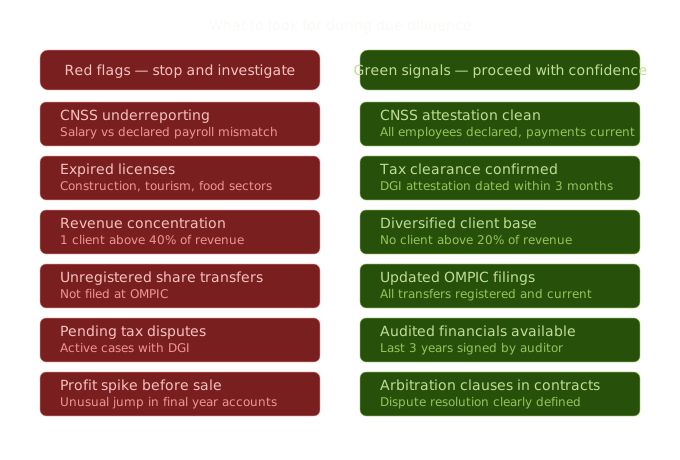
- Undeclared employees or salary underreporting to CNSS
- Expired licenses — especially in construction, tourism, and food
- Share transfers not registered at OMPIC Lease contracts missing notarization
- Revenue concentrated in one or two clients (above 40% in a single client)
- Shareholder conflicts not disclosed in official records
- Environmental non-compliance in industrial zones
- Bank accounts with undisclosed liens or guarantees
- Management unwilling to provide direct authority verification
- Financial statements showing sudden profit spikes in the year before sale
7. Common Pitfalls Buyers Face
Incomplete records — Many Moroccan SMEs lack proper bookkeeping. Missing years of accounts is common. This is not always fraud — sometimes it is simply poor administration — but it is always a risk.
Trusting seller-provided documents without verification — Always verify directly with OMPIC, DGI, CNSS, and the courts. A tax clearance certificate provided by the seller could be outdated or falsified.
Underestimating CNSS liability — This is the most common costly mistake in Moroccan acquisitions. CNSS liabilities are calculated retroactively and can cover years of underpayments.
Ignoring sector-specific regulation — Buying a construction company without checking building permits, or a food company without checking health certifications, can result in immediate operational shutdown post-acquisition.
Regulatory delays — Public records in Morocco can take 2 to 4 weeks to obtain. Build this into your timeline from day one.
8. How to Use DD Findings in Negotiations
Due diligence is not just a compliance exercise — it is your most powerful negotiation tool.
Every significant finding should translate into one of four actions: a price reduction reflecting the quantified risk, a specific indemnity clause where the seller guarantees to cover identified liabilities, an escrow arrangement where part of the purchase price is held back for 12 to 24 months pending resolution, or deal withdrawal if the risks are unquantifiable or unacceptable.
In practice, most Moroccan M&A deals are renegotiated after due diligence. A well-executed DD process typically results in a price adjustment of 5% to 20% from the initial offer making the cost of due diligence one of the best investments in the transaction.
9. Public Deals vs Private Deals — Key Differences
| Criteria | Public Deal (listed company) | Private Deal (SME or unlisted) |
| Regulatory oversight | AMMC mandatory | No regulatory approval required |
| Document availability | Public filings available | Relies entirely on seller cooperation |
| Timeframe | 8–16 weeks | 4–8 weeks |
| Main risk | Market disclosure obligations | Hidden liabilities and informal practices |
10. Sector-Specific Risks in Morocco
Manufacturing and Industry — Environmental compliance under Law 12-03 is critical. Industrial zone companies often have unresolved environmental violations. Also check collective bargaining agreements carefully — labor disputes are common in industrial companies.
Real Estate and Construction — Verify all building permits directly with local authorities. Check for unauthorized construction or zoning violations. Real estate titles must be verified at the Conservation Foncière.
Retail and Distribution — Revenue concentration and exclusive distribution agreements are the main risks. Also verify commercial leases — many Moroccan retail leases are informal and not notarized.
Tourism and Hospitality — Sector licenses from the Ministry of Tourism expire and must be renewed. Labor compliance is often weak in hospitality, with high levels of informal employment.
Renewable Energy — Contracts with ONEE (Office National de l’Électricité) and MASEN must be verified. Grid connection agreements and environmental impact studies are critical.
Financial Services — Bank Al-Maghrib authorization is required and non-transferable. Any acquisition of a licensed financial institution requires full regulatory approval.
11. Typical Timeline and Costs
For a standard Moroccan SME acquisition:
- Weeks 1–2: Document collection and data room setup
- Weeks 2–4: Core review — legal, tax, CNSS, contracts
- Week 4: Management interviews and authority verification
- Week 5: Risk matrix preparation and report drafting
- Week 6: Negotiation support and closing recommendations
These fees are almost always recovered through price adjustments identified during the process.
12. Best Practices for Foreign Investors
Always verify documents directly with Moroccan authorities — not just what the seller provides. OMPIC, DGI, CNSS, and the courts all have verification mechanisms.
Work with a local bilingual team — French and Arabic. Many critical documents exist only in Arabic, including court records and certain regulatory filings.
Request warranties and indemnities in the sale agreement covering all identified risks with a minimum 3-year coverage period.
Compare payroll, tax declarations, and CNSS data for inconsistencies. Any mismatch between what the company declares to the tax authority and what it pays employees is a major liability signal.
Use arbitration clauses for cross-border deals. The ICC or CIRDI arbitration centers are preferred for international investors. Moroccan courts, while improving, are slow for complex commercial disputes.
FAQs
Is legal due diligence mandatory in Morocco?
For public deals regulated by AMMC, certain disclosures are mandatory. For private deals, it is legally optional but commercially essential. Most international buyers and lenders require it as a condition of investment.
How long does it take?
Between 4 and 8 weeks for SMEs. Larger or more complex companies can take 12 to 16 weeks, especially if public records are slow to obtain.
What are the most important documents to request first?
RC extract from OMPIC, ICE certificate, tax clearance from DGI, CNSS compliance attestation, last 3 years of financial statements, and all major contracts.
What is the biggest risk in Moroccan acquisitions?
Tax and CNSS liabilities that transfer automatically to the buyer. These can represent years of underpayments and are the most common source of post-acquisition disputes.
Can foreign buyers conduct due diligence remotely?
Partially. Documents can be reviewed remotely through a virtual data room. However, direct authority verification — at OMPIC, DGI, CNSS, and local courts — requires a local representative in Morocco.
Do Moroccan courts accept English-language documents?
No. All documents submitted to Moroccan courts must be in French or Arabic, with notarized translations if originating from a foreign language.
Conclusion
Legal due diligence in Morocco is not a formality — it is the foundation of every successful acquisition. It uncovers risks before they become your liability, strengthens your negotiating position, ensures compliance with Moroccan law, and gives you the confidence to close the deal or walk away at the right moment.
Whether you are preparing for a public deal regulated by the AMMC or a private acquisition of a Moroccan SME, the process is the same: verify everything directly, quantify every risk, and never sign before your advisors have given you a clear picture of what you are buying.
Neo Expertise supports foreign investors and companies with full legal and financial due diligence across all sectors in Morocco. Our team combines accounting, tax, and legal expertise to give you a complete picture — not just a checklist.

Brahim Rami | Member of institute of chartered accountants in Morocco
He is a CPA and tax advisor, founder of NeoExpertise.net, a Legal and Tax firm helping foreign companies with business setup, due diligence, payroll, and tax compliance in Morocco and Africa.